GERALD WINEGRAD: WHAT THE DECLARATION OF INDEPENDENCE MEANT FOR NATIVE AMERICANS | COMMENTARY
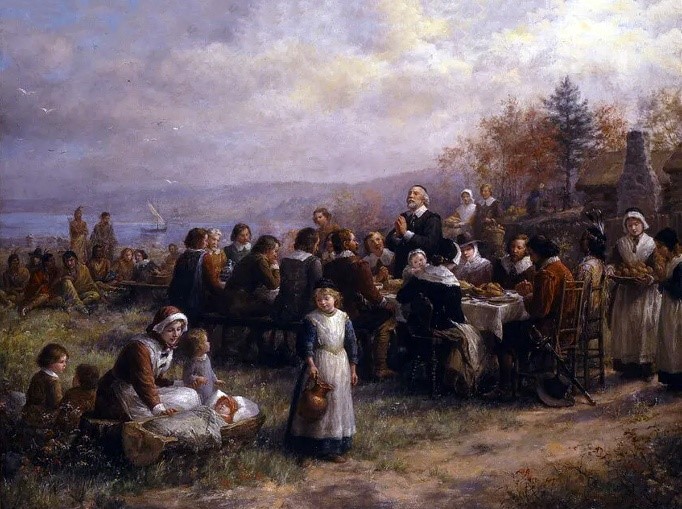
Stylized painting by Jennie Augusta Brownscombe of Thanksgiving at Plymouth. By 1640, only 1,000 Wampanoags remained from 70,000 in 1621, victims of colonists’ diseases, killing, and enslavement. (National Museum of Women in the Arts/Courtesy)
As we celebrate the 250th anniversary of declaring our independence from England and its king, there has been a torrent of written and visual reflections on our hallowed Declaration of Independence and its global historical importance.
One example is the harsh reality of Native Americans trapped in a lose-lose situation during the Revolutionary War. Tribes were forced to choose sides, with protecting their ancestral homelands pivotal as the war was focused deeply on who controlled land, particularly Native lands.
Many of our Founding Fathers were land speculators seeking to gain enormous acreages of Native lands west of the Appalachians. They included Washington, Jefferson, Franklin and Patrick Henry. Robert Morris, a wealthy Philadelphia merchant known as the financier of the American Revolution, was a major speculator. He is one of two founders to sign all three of the nation’s founding documents.
These speculators and other colonial leaders resented British restrictions against the illegal settlement and seizure of Native lands beyond the Appalachians. A 1763 Royal Proclamation forbade colonists from settling west of the Appalachians, reserving that territory for Indigenous nations. Our wealthy Founding Fathers and other land speculators’ resentment served as one of the catalysts for the declaration and Revolutionary War.
Armstrong Williams’ July 1 commentary, “The American history we rarely tell,” wisely noted that “The American story did not begin on July 4, 1776. It began thousands of years earlier with Native peoples who built thriving civilizations, cultivated the land, established trade networks and developed rich cultural and spiritual traditions.”
The declaration ignored this. It detailed grievances against King George to support independence. Grievance 7 condemned the king for attempting to stunt the colonies’ growth. It specifically targeted his efforts to restrict westward land expansion. “He has endeavored to prevent the population of these States; for that purpose obstructing the Laws for Naturalization of Foreigners; refusing to pass others to encourage their migrations hither, and raising the conditions of new Appropriations of Lands.”
Further contempt for our Indigenous peoples appears in the 27th and final grievance in our hallowed Declaration of Independence: “He has excited domestic insurrections amongst us, and has endeavored to bring on the inhabitants of our frontiers, the merciless Indian Savages, whose known rule of warfare, is an undistinguished destruction of all ages, sexes and condition.”
The first part of this complaint targets British Virginia Governor Lord Dunmore’s November 1775 proclamation promising freedom to any enslaved person who fled and joined the British Army. This concern over slave rebellions replaced Thomas Jefferson’s original draft statement condemning slavery and the transatlantic slave trade.
The second part of the grievance expresses utter contempt for our Native people. European expeditions to the New World were financed by kings and private land companies for the exploitation of its resources and Natives. The 1632 charter from King Charles I to Lord Baltimore granting him Maryland had no consideration of the owners/occupiers of this land, noting that it was “partly occupied by Savages, having no knowledge of the Divine Being.”
By virtue of military conquest, the king gave their land away, keeping a cut of the profits. The charter provided that the “New Colony should happily increase by a Multitude of People and … be more firmly secured from Incursions of Savages, or of other Enemies.” Favored colonizers were to seize the land of “savages,” exploit it for profit and deal with “savages” as they saw fit.
One scholar wrote: “The decline of Native American populations was rapid and severe, probably the greatest demographic disaster ever.” From 1600 to 1700, their numbers dropped by 50% and by another third from 1700-1800. The Declaration of Independence and its seminal statement that “All men are created equal” clearly did not apply to Natives.
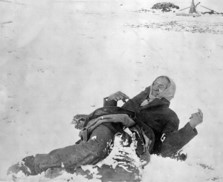
The dead body of Lakota Sioux Chief Spotted Elk lies in the snow after being killed by U.S. Calvary soldiers at the Wounded Knee Massacre, South Dakota, December 29, 1890. He was one of about 250 Lakota people killed, including women and children, on the Pine Ridge Reservation where they were forced to live. Historian Jeffrey Ostler called the massacre “a series of acts held together by an underlying logic of racist domination.” (U.S. National Archives and Records Administration)
Despite the declaration’s condemnation of Britain’s recruitment of “the merciless Indian Savages,” a young George Washington recruited and relied heavily on Native allies to fight alongside his Virginia militia and serve as scouts during the French and Indian War in the Ohio Country. This war was centered around control of North American land, including Native land.
England prevailed, taking control of Canada and other French possessions.
At the war’s conclusion in 1763, King George III issued the proclamation mentioned above, prohibiting colonists from settling on Native lands west of the Appalachians. England was in deep debt and could not afford another costly conflict with Indigenous tribes.
Washington and the Continental Congress actively recruited Native Americans to fight for the Patriot cause just weeks after forming the Continental Army in July 1775. Congress appointed Benjamin Franklin to lead the newly established Indian Department to secure alliances or neutrality. Washington and the Congress recognized the immense strategic value of Indigenous fighters.
Members of the Stockbridge-Munsee community from western Massachusetts fought for the Patriots at the battles of Lexington and Concord on April 19, 1775. They served as minutemen, ambushing and firing upon British troops. Because their communities were surrounded by colonial settlements, the tribe sided with the rebel colonists, hoping that their military service and loyalty to the Patriot cause would help protect their remaining land rights.
Despite their critical military support for the Patriot cause, after the war the Stockbridge-Munsee people faced devastating dispossession. White settlers violently encroached on their Massachusetts lands, forcing the tribe to migrate westward. They were not alone in this betrayal. The Natives who scouted and fought in Washington’s army in many battles, including Oriskany, Saratoga, Barren Hill and Quebec, also faced dispossession of their ancestral lands.
Although many tribal groups remained neutral, significantly more Native Americans fought for the British as they believed their allegiance was the best way to protect their lands and halt colonial expansion. British generals began actively recruiting Native Americans as early as 1775 during the invasion of Canada.
Colonists were also divided, with about 40% Patriots (rebels), 20% Loyalists and 40% neutral “fence-sitters” who just wanted to live in peace. Some historians term the war a civil war.
As an inducement to recruit reluctant colonists to enlist, Congress and states offered “bounty lands” in Native western possessions. While Natives were fighting against the British, native lands were being offered to colonial enlistees. In 1787, Bounty Land Warrants were issued, typically for 160 acres. These were Natives’ ancestral lands they had occupied for thousands of years.
Natives who fought with the British fared no better. Under the 1783 Treaty of Paris ending the war, England ceded territory all the way to the Mississippi River. Despite most of the continent being occupied by Indigenous tribes, their lands received no protections, and their sovereignty was ignored under the Treaty.
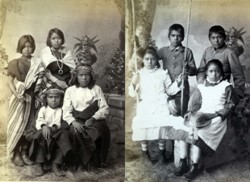
Carlisle, Pennsylvania, Indian School was the first federally funded off-reservation Indian boarding school. From 1879 to 1918, 7,800 Native children were taken from their parents to be assimilated into Euro-American culture. These before and after pictures were of Pueblo children removed from their New Mexico homes to show success with assimilation. (Carlisle Indian Industrial School Digital Resource Center)
The 19th century saw expedited Native dispossessions, land seizures, broken treaties and open warfare against tribes who resisted the theft of their ancestral lands. In 1830, the Native Removal Act banished the remaining 80,000 Natives living in the east to west of the Mississippi, resulting in the Trail of Tears and 25,000 Native deaths. The U.S. also forced assimilation through Indian schools, attempting to obliterate native cultures.
The exterminatory violence against natives over the centuries causes me to ask: Who were the real savages? Our abuse of once-Native land continues. The stain of Native genocide remains on America’s soul.
Gerald Winegrad represented the greater Annapolis area as a Democrat in the Maryland House of Delegates and Senate for 16 years. Contact him at gwwabc@comcast.net.