GERALD WINEGRAD: THE SHOCKING TRAGEDY OF THE CHESAPEAKE BAY | COMMENTARY
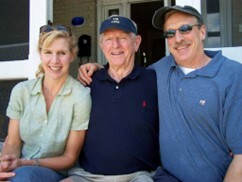
Retired Navy Captain and Naval Academy graduate Ted McClanahan with two of his four children. His life was cut short on July 1, 2023, by a vibrio vulnificus infection from Severn River water contact after a leg cut. He died 4 days after the water contact. (Courtesy/McClanahan Family)
Like Vito Corleone, the Godfather tending his tomato plants, in my supposed retirement, I spend each summer day tending my two crab pots on my Oyster Creek pier. I cherish catching my favorite food and feasting on steamed crabs in Old Bay with Maryland corn on the cob with Carol and others. This is how it is supposed to be in the Land of Pleasant Living. We just enjoyed 14 of these delectable crustaceans while watching the Orioles play the Yankees.
But to my grave disappointment, all is not well with this scenario, and it’s not the Orioles. In tending my pots, I must armor myself regardless of humid, sweltering days, donning long pants, a long-sleeved shirt and gloves — because of the growing incidents of life- and limb-threatening bacterial infections from bay water contact.
A small cut from a crab, a pot or my live box could allow bacteria, including Vibrio vulnificus (the deadliest), to enter my bloodstream. Vulnificus kills one in five people contracting it, and it is a most unpleasant death.
This bacteria is not alone in causing necrotizing fasciitis, where your flesh is eaten from the inside out. There are 80 other species of Vibrio, with a dozen causing human health problems in the bay. Other infectious bay organisms include Aeromonas hydrophila, which can threaten life and limb. A milder but harder to detect infection comes from Mycobacterium marinum.
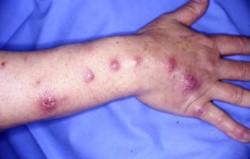
A common Mycobacterium marinum infection associated with waterborne bacteria and fish handling. Slow growing, it is hard to diagnose but treated with antibiotics. (AquaInfo)
These bacteria occur naturally in our waters, but they flourish, multiplying in the bay’s warm, brackish and salt water fueled by excess nutrients feeding algal growth, which triggers bacterial growth and increases its toxicity. The warmer the water and the more nutrients, the greater the danger. Global warming and nutrient pollution have created a nightmarish situation with bay waters more dangerous than we could ever have anticipated.
I have met and seen victims of these infections and know well the widow of one victim’s death four days after cutting his leg in the Severn River in Annapolis. Tragically, my daily armoring is a reminder of the depressing decline of the Chesapeake and the false claims of success by the U.S. EPA, bay state governors and their environmental agencies, some conservation groups and scientists.
This greenwashing conceals their refusal to take the necessary steps to reduce nutrients from agriculture, development and forest clearing and to fight global warming with meaningful actions. Some of these same actors and health departments have tended to minimize news of these infections, terming them rare. This is to prevent embarrassment to political leaders and damage to tourism and fishery marketing,
My concerns were validated by statements from Dr. Rita Colwell at the University of Maryland. She is one of the most respected Ph.D. marine microbiologists researching waterborne infections. She declared that “You’ve got a catastrophe in the making,” warning that rising water temperatures and nutrient pollution create low-oxygen conditions that dramatically change Vibrio and other infectious microbial populations, escalating infection risks. As climate change warms the Chesapeake, Vibrio prevalence is lengthening and growing.
She and her collaborators found Vibrio hospitalization rates in Maryland were almost 60% higher between 2013 and 2019 than from 2006 to 2012. And it is going to get worse: “And so we are, in fact, you know, the canary in the coal mine. Maybe it’s time to shout. … The future is bleak, and I worry about my grandchildren.” In 2023, researchers found that since the late 1980s, Vibrio vulnificus infections increased about eightfold in the east.
An estimated 80,000 U.S. vibriosis cases are reported annually to the CDC, including 150 to 200 cases of Vibrio vulnificus. Cases are likely grossly underreported. Most Vibrio cases are from the ingestion of raw seafood, as cooking kills the bacteria. The Maryland Health Department reports that from 2015 to 2025, there were 1,216 confirmed or likely vibriosis cases. At least 342 people were hospitalized, and 25 died. Vibriosis cases are increasing, rising from 38 in 2015 to 260 in 2025, with six deaths reported that year.
My awareness of such cases began in 2007 from Bernie Voith, who contracted a Vibrio vulnificus infection from a leg cut in the Severn’s Plum Creek in 2005. This resulted in emergency room care where his doctor concluded that “he was almost on the verge of death by the time he was admitted to the hospital.” Bernie spent two weeks in the hospital getting intravenous antibiotics. After four months of treatment, he eventually recovered despite the flesh-eating disease costing him part of his calf, which he showed me.
Jay Sadowski, the best car mechanic we ever had, contracted a Vibrio vulnificus infection in 2013, cutting his hand while fishing in the South River. Days after being taken to Shock Trauma, much of his leg flesh was eaten away. It cost him his business and eventually his life, as he had leukemia, which was aggravated by his infection. Jay died in 2014 at 59. I urge you to go to mdstormwater.org and view the 30-second TV videos of Bernie and Jay, which ran in 2024. Dogs are also subject to serious flesh infections from water contact, and one such case is covered on this website.
On July 6, 2025, a neighbor contracted a flesh-eating disease, 75 yards from my pier. A cut on his shin from tending a fish trap led to an Aeromonas hydrophila bacterial infection. The necrotizing infection quickly ate away nearly all of the soft tissue on the front and back of one leg despite emergency surgeries, intravenous antibiotics and the transfer from our local hospital to Shock Trauma.
He and his wife were close to having to decide whether to have his leg amputated or face death. But Dr. Sharon Henry’s surgical skills with skin grafts and her experience with necrotizing diseases saved both life and limb. She was treating five other similar cases and noted that it was the worst year they have seen for bay water infections.
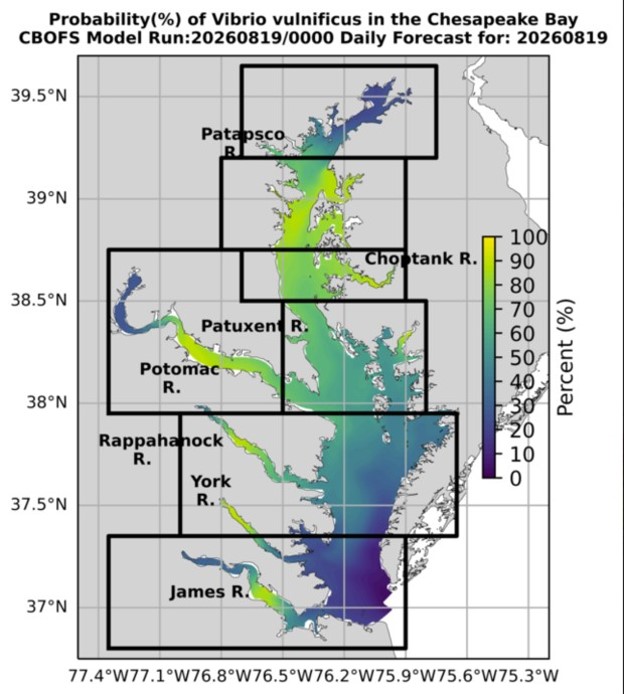
This NOAA chart documents a very high probability (80%+) that deadly Vibrio vulnificus bacteria is present in bay waters in our region, among the highest in the entire bay system. (NOAA-NCOS)
The prevalence of such infections triggered the Maryland Health Department to issue new warnings this month, which included a warning not to eat raw or undercooked shellfish or crabs. It also counseled to avoid exposing open cuts, sores, recent piercings or tattoos to raw shellfish, crabs and coastal or brackish waters.
The shocking part is that for the first time in Maryland history, we are being told never to eat raw oysters. Next to crab, oysters are my favorite food, and I have eaten thousands on the half-shell with no problems. This winter will be a test as to whether I abstain.
While dangerous vibrio and other bacterial infections are downplayed, we are bombarded daily in national and local news about the much less debilitating cyclosporiasis, an intestinal illness caused by a microscopic parasite with lettuce, other greens and berries suspected carriers. Maryland has seen 148 cases this season, with nearly half from overseas travel. Very few cases require hospitalization.
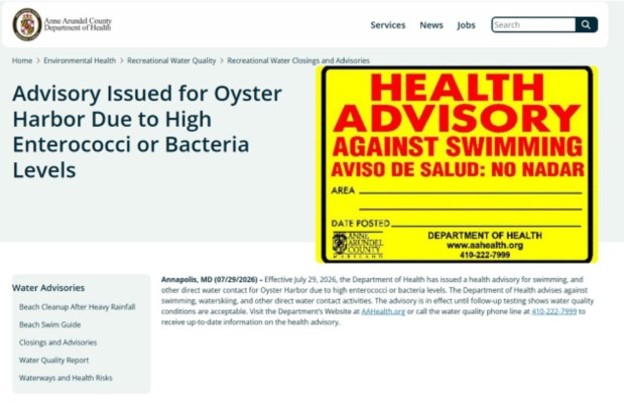
A July 29 Health Advisory Notice closing our Oyster Harbor Community beach because of very high bacterial levels. Other beaches were also closed as bacteria flourish in warming waters. (AA County Health Dept.)
Next week, I will explore what should be done to reverse this descent into ecological hell.
For more details and discussion of “The Chesapeake Bay’s Dirty Secret,” attend my presentation at 49 West Street Coffeehouse and Winebar for Annapolis Cafe Scientifique at 6 p.m. this Thursday, Sept. 27. Reserve your seats at 410-626-9796. There is no charge.
Gerald Winegrad represented the greater Annapolis area as a Democrat in the Maryland House of Delegates and Senate for 16 years. Contact him at gwwabc@comcast.net.