GERALD WINEGRAD: CONSERVATION OF ROCKFISH, OSPREY AND MENHADEN IS AT STAKE | COMMENTARY
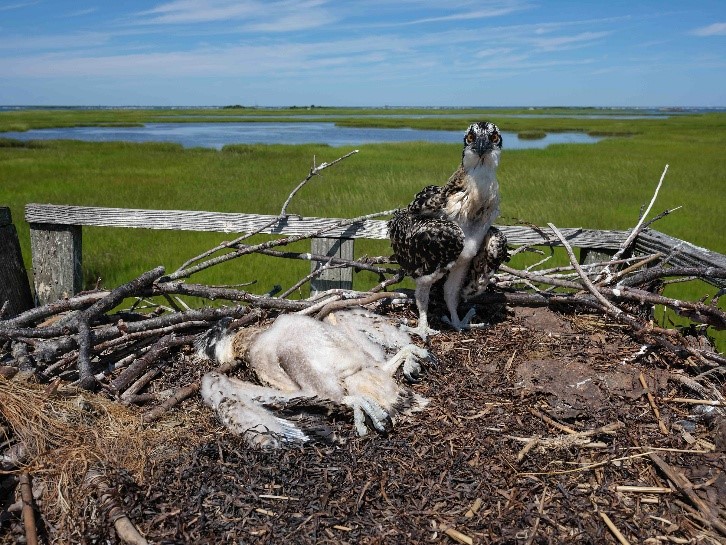
A starving young osprey stands next to its dead sibling, one of 5,000 osprey babies to die in Chesapeake Bay from starvation this year linked to a lack of menhaden. (Ben Wurst/American Bird Conservancy)
There is a raging conservation issue that revolves around a fish that no humans eat and most have never heard of. It has brought over 45,000 citizens and 60 national and local conservation organizations and dozens of fishery groups together to demand immediate and substantial reductions to the hundreds of millions of these fish allowed to be harvested each year.
These demands have been reinforced by 29 Maryland legislators, 22 Democrats and seven Republicans — yes, there is bipartisan agreement among these legislators on this issue. Ten members of Congress joined in a letter urging strong conservation measures for this fish. They were led by Maryland U.S. Sen. Chris Van Hollen and joined by our other U.S. senator, Angela Alsobrooks, four other U.S. senators and four members of the U.S. House of Representatives.
A former Maryland governor has also weighed in, supporting the strongest restrictions on harvest proposed. Maryland is the most affected state by the unrelenting, massive butchering of this oily but critically important fish. It has been called “the most important fish in the sea.” The star of the show is the lowly menhaden, also known as bunker and pogy. This species is the unsung hero of marine life in the Chesapeake and along the Atlantic coast.
Its oily, dense protein provides food for millions of other fish, especially rockfish, as well as whales, sharks and birds, especially ospreys. Other popular sport and commercial species known to rely on menhaden include bluefish, cobia, red drum (redfish), sea trout, bluefin tuna, mackerels and summer flounder.
One Canadian-owned company, Omega Protein, is allowed by Virginia and the Atlantic States Fishery Management Commission (ASMFC), an interstate fishery management body, to swallow up 67% of the entire East Coast allowance of menhaden. The fish are harvested with massive nets from ocean-going purse seiners. Maryland banned the use of such purse seiners in its waters in 1931. Only Virginia allows such industrial purse seine harvesting for menhaden.
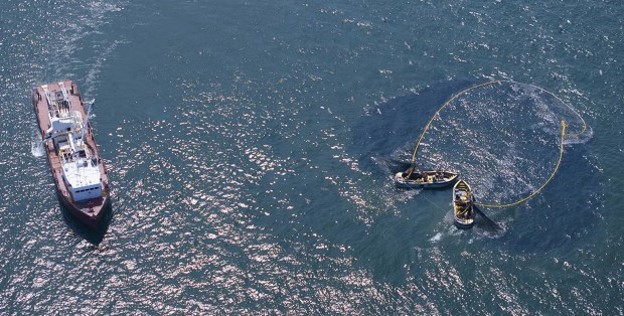
The harvest of tens of millions of menhaden is threatening rockfish, osprey and other species dependent on this oily, protein dense fish. Only Virginia allows ocean purse seiners to fish in its waters. Maryland banned them in 1931. (TRCP/CosmoVision Media)
Virginia hosts the only menhaden reduction factory left on the East Coast. Owned by Omega Protein, a subsidiary of Canada’s Cooke Inc., it cooks and grinds down hundreds of millions of the smallish menhaden to produce fishmeal, fish oil and soluble fish protein. The vast majority of the fish meal and fish oil is sold as feed for farmed fish, livestock and domestic pets. The fish oil is used in dietary supplements, food additives and health products.
Absurd as it may sound, Omega Protein and its handmaiden, the state of Virginia, have manipulated the ASMFC to give the state 75.21% of the entire coastal harvest quota, from Maine to Florida. The ASMFC is a federally created body with authority to regulate migratory fish species. Virginia gives Omega Protein 90% of its allocation, or 67% of the coastal harvest. Maryland receives 1.17% of the harvest, mainly for stationary pound nets to catch menhaden for crab bait.
This massive take of hundreds of millions of menhaden for the reduction fishery has led to significant problems for rockfish, other fish species, ospreys and Maryland’s small harvesters. How does Omega Protein get away with this? The capture and processing of such immense amounts of this keystone species is a big money maker. The Canadian conglomerate Cooke Inc. bought Omega Protein from a Houston company for $500 million in 2017.
The company donates liberally to Virginia governors and legislators, $1.1 million in recent years. Gov. Abigail Spanberger got $50,000 this year for her inaugural committee. Omega Protein deploys Richmond lobbyists from one of the most powerful lobbying firms in the East, McGuireWoods, termed Virginia’s second government. It is staffed heavily by individuals who previously ran the state, including former governors, attorneys general, state secretaries and legislative chiefs of staff.
Omega Protein has also hired a PR firm on this issue, Stove Boat Communications. They cleverly distort the facts to ensure their client’s unfettered capture of menhaden. Omega Protein also pays a former New Jersey fishery staffer who sat on the ASMFC’s Atlantic Menhaden Technical Committee. He now advocates blocking menhaden restrictions.
The results of this brazen but legal corruption of proper fishery management are an ecological disaster. Rockfish reproduction in the bay collapsed to very low levels for eight years in a row, and the ASMFC has declared the species overfished, forcing substantial cuts in their recreational and commercial harvest. Menhaden once provided 70% of the rockfish diet in the Chesapeake; a dietary study showed it reduced to 8%. Some rockfish are emaciated from the lack of prey.
Other bay fish species are in decline, which may be linked to the decline of menhaden.
Osprey reproduction is collapsing in the bay, with an estimated 5,000 chicks dying from starvation in their nests in 2026. The reproductive rate has been reduced to lower than the DDT period. Osprey scientists predict a 50% decline in 10 years if action is not taken. In the 1980s, menhaden provided 75% of Chesapeake osprey diets in bay areas. In 2026, less than 30% of ospreys’ diets were menhaden. A new study also documents significant osprey reproductive failure in many other areas along the Atlantic coast.
Menhaden fishers in Maryland cannot find enough menhaden to make economic sense, leaving crabbers struggling to find affordable bait. Since 2017, Maryland has been unable to harvest even half of its small quota. More recently, Marylanders harvested less than 10% of their quota. Harvest dropped by more than 80% since 2020.
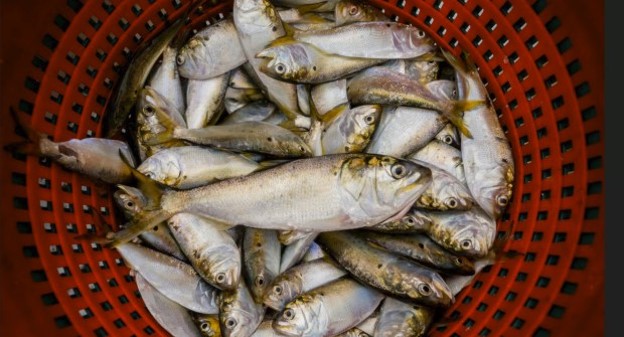
Menhaden are called “the most important fish in the sea” because they feed rockfish, bluefish, whales, dolphins, ospreys and many other species all along the U.S. Atlantic coast. Canadian owned Omega Protein is depleting their numbers enabled by Virginia. (ASMFC)
The Potomac River Fishery Commission 2025 harvest crashed to 2.4% of the 1964-2025 average and 8.2% of the 2024 take. In 2025, the Omega Protein reduction fishery could catch no more than 68% of its Chesapeake allowance. The evidence is that menhaden are in trouble beyond the bay. In 2025, only 63% of the coastwide quota was taken, and Omega Protein could catch only 60% of its quota. We are simply running out of menhaden.
D-Day for menhaden, rockfish and ospreys is Nov. 10 and 11, when the ASMFC will vote on proposals to significantly cut menhaden harvest. The ASMFC’s Atlantic Menhaden Technical Committee recently found that to meet ecological measures for rockfish recovery, the catch limit needs to be reduced by 39% to 114,200 metric tons (which is 252 million pounds or more than 300 million menhaden). This is to ensure about a 50-50 chance of attaining menhaden at a level necessary to achieve rockfish recovery by 2029.
A more risk-averse approach is to cut the harvest to 100,000 metric tons for the next three years and to cut the Chesapeake Bay harvest by at least 50% as advocated by conservationists.
From a conservation standpoint, these harvest cuts are the right thing to do. But given the tragic history of fishery collapses where economic forces overcame science-based fishery management, the decision of the ASMFC commissioners is in doubt.
Gerald Winegrad represented the greater Annapolis area as a Democrat in the Maryland House of Delegates and Senate for 16 years. Contact him at gwwabc@comcast.net.