AS CHESAPEAKE RESTORATION CRASHES, GREENWASHING PERVADES
The Chesapeake Bay is being polluted with huge flows of farm pollutants and environmental greenwashing. Elected and appointed government officials are aided and abetted by supposed conservation leaders. Government officials are driven by hypocritically burnishing their Green credentials with nothing-burgers while avoiding offending polluting interests.
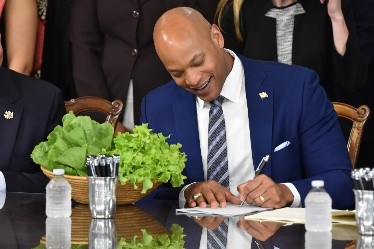
Gov. Wes Moore (D) signs the Chesapeake Bay Legacy Act on May 13, 2025, with a basket of greens brought by a Montgomery County farmer to celebrate the signing. (Photo by Bryan Sears/Maryland Matters)
Some environmental organization leaders are also driven to claim significant policy successes when there are none. This is done to ensure that they do not lose governmental and private funding by criticizing the lack of meaningful measures to significantly curb Bay pollutants. These opportunists have become environmental mercenaries.
Sadly, gone are a formerly robust group of experienced environmental journalists. The few new ones are overburdened with other assignments and succumb to Greenwashing.
A prime example is the Chesapeake Bay Legacy Act. On May 14, Maryland Matters reported on the bill’s signing, dutifully quoting its progenitor, Gov. Wes Moore: “This is the most comprehensive piece of Chesapeake Bay legislation that Maryland has seen in years.”
This is a Trumpian overstatement of epic proportions reminiscent of former Gov. Larry Hogan’s discredited claim in 2019 that his efforts resulted in a Chesapeake Bay “cleaner than it has been in recorded history.”
A close examination of Moore’s Legacy legislation reveals that it does very little if anything to reduce the Bay’s major pollutants of nitrogen, phosphorus, sediment and toxic chemicals. Maryland Matters welcomes guest commentary submissions at editor@marylandmatters.org.
We suggest a 750-word limit and reserve the right to edit or reject submissions. We do not accept columns that are endorsements of candidates, and no longer accept submissions from elected officials or political candidates.
Opinion pieces must be signed by at least one individual using their real name. We do not accept columns signed by an organization. Commentary writers must include a short bio and a photo for their bylines.
Maryland Matters also gave a mostly favorable boost to Moore’s “complex” legislation on Feb. 11, mostly parroting Moore and his secretary of Agriculture’s propaganda.
The reporting did note that “Gov. Wes Moore (D) announced with some fanfare in the fall that he planned to introduce legislation during this year’s General Assembly session to expand and modernize Maryland’s efforts to protect the Chesapeake Bay, telling assembled leaders from every state in the Bay watershed, ‘It’s up to us to protect it.’” Moore was speaking as chair of the Bay Program’s Executive Council.
Moore is obviously desperate to burnish his presidential cred, as was Hogan. The legislation changes little in the status quo so as not to upset agribusiness and commercial fishing interests that might impede his presidential ambitions. From my 55 years of environmental advocacy, I can discern greenwashing, and this bill epitomizes such.
Let’s examine the Legacy Act’s details: First, a person who has a tidal fish license or commercial channa license and harvests and processes finfish on a vessel by ikejime for direct sale to restaurants need not have a food establishment license. Secondly, minor changes are made regarding the procedures for adoption of fishery management plans. Nothing is included that would better conserve crashing fish and crab populations.
Aquaculture regulations are tweaked but there are no needed changes to better advance oyster aquaculture. The bill allows publicly funded oyster restoration projects to generate water quality trading credits allowing pollution reductions from planting oysters to be traded for increased pollution elsewhere. In a separate bill, oyster poaching penalties are relaxed.
The Legacy Act establishes a Water Quality Monitoring Program in the Department of Natural Resources that simply formalizes the existing water quality monitoring system. Big deal.
But the major initiative in this grab bag is yet another voluntary agricultural program termed LEEF, Leaders in Environmentally Engaged Farming. Despite my repeated efforts to dissuade the secretary of Agriculture from such a meaningless approach that would waylay needed regulatory efforts, the legislation was enacted into law. The secretary acknowledged publicly that voluntary farm measures have failed to achieve the necessary pollution reductions.
Farmers who choose to may apply for certification to be created akin to LEED building certifications except this is entirely voluntary and there are no details on its implementation or on attaining certification levels except: Credit must be given for preserving farmland, participation in farmers markets, donations to food banks, on-farm research and for farmers lecturing about agriculture.
Instead of acting to curb the largest source of Bay-choking pollution by better regulatory measures and enforcement, and despite knowing that voluntary farm measures do not work well, LEEF would perpetuate the desecration of our environmental legacy. LEEF already was used to defeat legislation requiring riparian buffer plantings on 2,665 acres of Critical Area farmland.
Remarkably, the Chesapeake Bay Foundation’s president is quoted supporting this fraud: “With federal cuts and rollbacks looming heavily on our state, Maryland’s environmental leadership is more important than ever. This Act will help maintain forward momentum and ensure that investments in clean air, clean water, habitats, and local economies are secured.”
With such gubernatorial and NGO leadership, may God Save The Bay!