COMMENTS AND RECOMMENDATIONS ON THE DRAFT 2025 CHESAPEAKE BAY WATERSHED AGREEMENT
We hope citizens will push back and submit comments on the currently weak and inadequate Draft Plan. Comments are being accepted into September at comments@chesapeakebay.net
——————————–
Please accept and consider these comments with specific recommendations for changes and additions to the draft Revised 2025 Chesapeake Bay Watershed Agreement, hereinafter referred to as the “Draft”.
These comments are submitted by former Maryland state Senator Gerald W. Winegrad and Patuxent Riverkeeper Fred Tutman. Together we have more than 80 years of advocacy, policy, and teaching experience related to the restoration of the Chesapeake Bay. See our backgrounds in the Bios attached to our email message submitting our comments to you.
SHORTCOMINGS IN THE DRAFT.
We find the Draft deficient in what is needed to effectuate Bay restoration and fully meet the Bay states’ previous commitments in their Watershed Implementation Plans (WIPs), under the EPA dictated 2010 TMDL, and in the most important commitments under the 2014 Agreement that the Draft will replace. The Draft is considerably weakened from the 2014 Agreement in many critical commitments. These flaws render the Draft incapable of effectively guiding restoration beyond 2025.
The draft document appears to be a politically compromised plan that lacks the bold but necessary initiatives to take us beyond 2025 to finally restore the Chesapeake Bay, a goal that has eluded us for more than 40 years under the Chesapeake Bay Program. It follows other Bay Agreements in 1983, 1987, 2000 and 2014 but is much weaker than the commitments in the 1987 and 2000 Bay Agreements. It even weakens terms not met in the 2014 Agreement.
All of these Agreements were solemnly committed to and signed by the Bay state Governors, Mayor of DC, and EPA Administrator and yet ailed to meet their commitments to reduce nitrogen, phosphorus, and sediment (hereafter N,P,S).
The latter three pacts committed the states to meet specific reductions in nitrogen and phosphorus; sediment was added in the latter two. Reductions in toxic hot spots also were part of several of the latter Bay agreements. These pollutant cuts were necessary to restore the Bay’s waters to meet basic federal Clean Water Act requirements. The voluntary accords detailed specific actions that states needed to take to meet pollutant reductions. The states repeatedly failed to meet these commitments and the reductions in N,P,S and toxic hot spots.
These failures forced the EPA, under the settlement of a 1999 federal court suit, to impose the Chesapeake Bay Watershed TMDL in 2010 requiring states to adopt WIPs to achieve CWA requirements for reductions in N,P,S—60% to be achieved by 2017 and 100% by 2025. Now, 15 years later and past the deadline, the EPA has chosen not to impose any sanctions or new requirements to meet the TMDL, basically making the Clean Water Act requirements voluntary.
The Draft avoids any mention of these failures, including meeting the TMDL requirements. Transparency and properly noting the historic setting under which the Draft is being developed demands that the short history above should be encapsulated in the Draft’s Preamble at p.5. This information should include data on the overall attainment of the Bay’s TMDL for N,P,S and for each Bay state.
MOST IMPORTANTLY, THE DRAFT SHOULD RENEW COMMITMENTS TO REDUCE N,P,S AS DICTATED BY THE 2010 EPA TMDL TO BE ADJUSTED BY NEW SCIENCE-BASED DATA DOCUMENTING INCREASES IN NUTRIENTS UNACCOUNTED FOR, AND TO IMPLEMENT THEIR ADJUSTED WIPs TO MEET THE TMDL
The Draft minimizes references to and compliance with the TMDL and WIPs which were supposed to be met by January 1, 2025. Instead, it states at p. 11 under Water Quality that:
“Through 2030, continue to implement and maintain practices and controls to reduce excess nitrogen, phosphorus, and sediment to achieve the interim water quality targets as determined by the Principals’ Staff Committee. Partners may meet this target by implementing their Phase III Watershed Implementation Plans, two-year milestone commitments or other innovative strategies.”
In addition, “By December 2030, update this outcome with revised targets that include a timeline to meet the updated water quality targets for nitrogen, phosphorus and sediment.”
Even though the EPA has chosen not to impose sanctions on state failures to implement their WIPs and meet their TMDLs, it is still the function of the EPA to enforce the CWA and impose and enforce TMDLs. This draft is a step backwards and embraces a kicking-the-can-down-the-road mentality. Allowing the states to lead and develop the new N,P,S caps makes a farce of Bay restoration by seemingly turning the Clean Water Act (CWA) and its TMDL process over to the states despite more than 40 years of their failure to meet voluntary commitments as well as the EPA-dictated TMDL and fully implement their WIPs so as to sufficiently curb N,P,S to meet CWA requirements.
The Draft omits references to the most critical commitment of the Bay states and EPA in the 2014 Watershed Agreement—to meet the TMDL and fully implement each state’s WIP. This omission tarnishes the entire process as this TMDL has guided restoration for 15 years, and supposedly still does. Meeting the reductions in N,P,S is the most important commitment in the 2014 Agreement as well as its predecessor, the 2000 Bay Agreement.
The first commitment in the 2014 Agreement under Goals & Outcomes under Water Quality reads: “By 2017, have practices and controls in place that are expected to achieve 60 percent of the nutrient and sediment pollution load reductions necessary to achieve applicable water quality standards compared to 2009 levels.
By 2025, have all practices and controls installed to achieve the Bay’s dissolved oxygen, water clarity/submerged aquatic vegetation and chlorophyll A standards as articulated in the Chesapeake Bay TMDL document.”
This is unequivocal and should not be ignored in the Draft as it is. This commitment should be emphasized and not ignored. Making matters worse, these critical commitments from the 2014 Agreement are abandoned in the draft so that instead of adhering to their WIPs and meeting the EPA TMDL, the states “may” use their WIPs if they choose. And there will be new undetermined interim water quality targets set by the Principals’ Staff Committee until December 2030 when undetermined revised targets and timelines will be set.
Compliance with the current TMDL and WIPs should be emphasized in a new Agreement!
Despite more than 70% of the Bay’s waters remaining impaired under the Clean Water Act, the Draft shifts responsibility for setting the terms of the TMDL for impaired waters to the states. This step backwards comes with zero new commitments to change the status quo and adopt any new initiatives to deal with the abject failure to adequality address agricultural nutrients and sediment and stormwater pollutants from developed lands, the overwhelming causes of the failure to meet the TMDL caps and leave more than 70% of Bay waters impaired.
This occurs as the EPA Bay Program concluded that the greater numbers of farm animals, increased farm fertilizers, ineffectiveness of BMPs, and impacts from more developed lands, have added 8 million pounds of annual nitrogen loads to the TMDL needing reduction. Nitrogen runoff from developed lands has increased by about 1.5 million pounds a year since 2009, not significantly decreased as pledged under the WIPs.
Global warming induced increased precipitation and intensity of storms, erosion, and rising sea levels washes more nutrients off the land adding about 5 million pounds of nitrogen annually back into the equation. And the filled reservoir of the Conowingo Dam adds an additional 6 million pounds of annual nitrogen reductions, mostly from Pennsylvania farmland.
That’s a whopping 19 million more pounds of nitrogen to be reduced! And yet, the Draft fails to mention this data, nor does it specify any commitments to curb agricultural and development nonpoint sources to reduce this increased influx.
Bay Program data also documents that computer generated nitrogen nonpoint source reductions have been overestimated by nearly 50% with little to no reductions from the agricultural sector since 2009.
Further, the latest Bay Program data documents that 78.26% of the Bay is contaminated with toxic impairments (2020). The Draft fails to mention this, nor does it contain any specific measures to reduce existing contaminants or stop the flow of additional contaminants.
The failure to recognize and fully address these serious issues is a fatal flaw in the Draft, condemning any Bay restoration plan under it to failure. These shortcomings should be covered in the Draft’s Preamble at p.5 and as noted below.
RECOMMENDATIONS TO RESOLVE THIS PROBLEM.
The following recommendations could be prominently included under Water Quality at p.11 or under Management Strategies at p.17.
Each Bay state must meet N,P,S reductions set in 2010 by fully implementing EPA-approved Watershed Implementation Plans by 2030. The TMDL limits shall remain until stricter limits are set by EPA by 2027 to account for an additional 19 million pounds of nitrogen from more intensive agricultural operations, urban development, the Conowingo dam reservoir, and global warming. And, by 2027 the EPA shall adjust nitrogen caps from non-point sources that have been overestimated by as much as 50% since 2010. By 2029, the states shall modify their WIPs to meet the additional loads of N, P, and S dictated by sound science and shall meet the additional reductions by 2033.
Under no circumstances should the new Agreement proffered in the Draft and the restoration plan under it abandon the TMDL and the Watershed Implementation Plans. They remain at the heart of the 2014 Bay Watershed Agreement, critical to achieving water quality. Abandoning these science-based limits, adjusted for increased nutrient loads as suggested above, because of states’ failure to meet them after being given 15 years, makes a sham of Bay restoration.
Transparency demands at least some details of where the states are currently in attaining their N, P, S caps set by the EPA in 2010 as adjusted by the Bay Program data for the additional 19 million pounds of nitrogen and for as much as a 50% adjustment for nonpoint source nitrogen achievements. This should be done for the entire Bay TMDL and for each state’s attainment. This accounting should be placed in the Preamble at p.5.
FOR TRANSPARENCY AND TO ASSERT THE REASONING BEHIND A STRONG NEW WATERSHED PLAN, THE FOLLOWING ELEMENTS OF WATER QUALITY ATTAINMENT AND THEIR EFFECTS UNDER THE TMDL SHOULD BE INCLUDED IN THE DRAFT.
There has been too much distortion in overstating the success of Bay restoration, partly due to politics, and partly due to trying to paint a more optimistic picture. But this tends to infect public support for the urgency of bold new measures to restore water quality as contemplated in the TMDL.
The Draft should include the critical data points pointed out above and below and not ignore the truth that we are very far off from meeting the most critical requirements of all Bay Agreements and the TMDL: to remove 100% of the Bay’s waters from the Clean Water Act’s Section 303(d) impaired waters list through the reductions in N,P,S as dictated. The following Bay Program chart is the single, greatest barometer of success or failure and of Bay health and should be inserted into the Preamble at p.5 or at the start of the Clean Water section at p.11 of the draft:
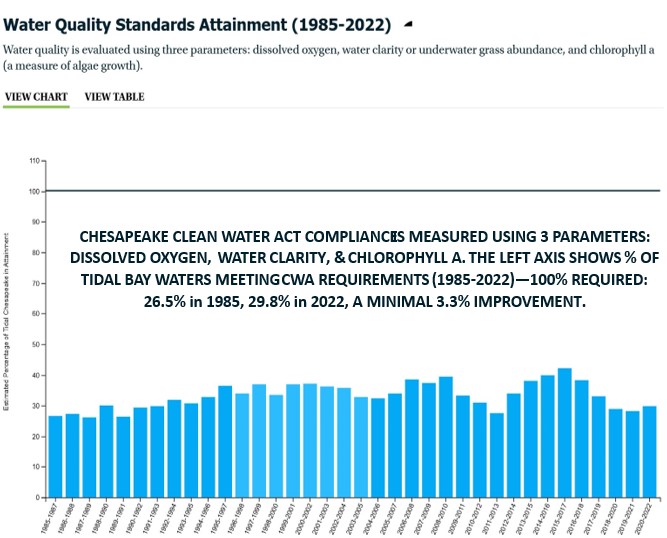
All concerned with the Draft and the health of the Bay should be alarmed that after 40 years of formal restoration under the Bay Program and the successive Bay Agreements and the TMDL more than 70% of Bay waters do not meet Clean Water Act requirements and are considered impaired.
This is despite more than $15 billion in public expenditures. We have moved from 26.5% of Bay waters meeting CWA requirements to 29.8%, a miniscule improvement likely due to the Bay Program’s singular success—substantial reductions of N and P flows from WWTPs. The $1.6 billion Maryland so-called flush tax is a shining example of what can be done when mandatory curbs are imposed, in this case under NPDES CWA permits for WWTPs. More than 95% of Maryland wastewater is under Enhanced nutrient removal, almost to the limits of technology and covering all 67 of the largest plants.
The Draft is silent on the Bay Program data shown in the chart and this data should be included at least in summary format in the Draft (Preamble at p.5 or Clean Water section at p.11) along with the following other indices of severe water quality problems: fishery collapses and declines, the gross failure to retore SAV as pledged to 185,000 acres, and the proliferation of flesh-eating diseases in humans.
THE FISHERY DISASTER IN THE BAY SHOULD BE NOTED IN THE DRAFT.
On March 15, 2023, Maryland Governor Wes Moore, Chair of the Chesapeake Executive Council, documented the widespread decimation of Bay fisheries in a letter to the U.S. Secretary of Commerce requesting compensation because of an “ongoing commercial fishery disaster in the Maryland waters of the Chesapeake Bay. … Since 2012, landings of seven of Maryland’s marquee commercial fishery species have declined between 27% and 91%. The dockside value of these species declined between 12% and 85%.” Here is the chart he submitted to support this fishery disaster in Chesapeake Bay:
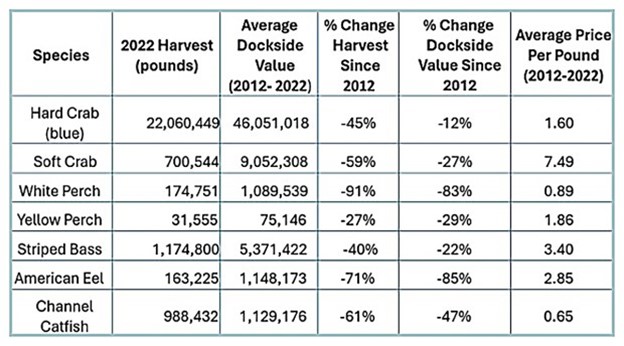
Left out of this petition for disaster assistance are the shad fishery which collapsed and has been closed in Maryland for 43 years and has not come close to recovering. Also left out is the soft-shell clam fishery which collapsed more than 50 years ago and still has not recovered.
Major factors in these fishery declines were poor water quality related to excessive N,P,S and the substantial loss of Bay grasses. Instead of seeking a federal declaration of a Chesapeake fishery disaster, the states should be focusing on the real disaster—the collapsing formal Bay restoration plans as the sates fall short on meeting their WIPs and pledges to curb N,P,S. This information and chart should be in the Thriving Habitat and Wildlife section at p.9.
INCLUDE INFORMATION ON FLESH-EATING DISEASES PROLIFERATING IN THE BAY LINKED TO EXCESSIVE NUTRIENTS AND WARMING WATERS.
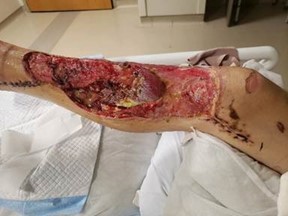
Flesh-eating diseases are proliferating in humans from water contact as serious infections eat away at limbs and even lead to death. These are caused by excessive nutrient flows fueling bacterial growth that flourish in warming water and become more toxic. Bacteria enter the bloodstream through open wounds. Vibrio vulnificus is the most dangerous and deadly, but other necrotizing bacteria persist along with other skin infections such as mycobacterium marinum.
This is Matt Dinsmore’s leg after cleaning his boat in the water of Kent Island, cutting his leg and contracting a vibrio vulnificus infection that almost killed him. He still has not fully recovered after operations and hospitalization:
Another victim was Jay Sadowski, an exceptionally good car mechanic. He cut his hand fishing in the South River. Days later, a vibrio vulnificus infection ate at his leg flesh and cost him his business. He vowed never to fish again in Bay waters. See Jay speaking on this website and view his leg: http://mdstormwater.org. He died in 2014 at 59.
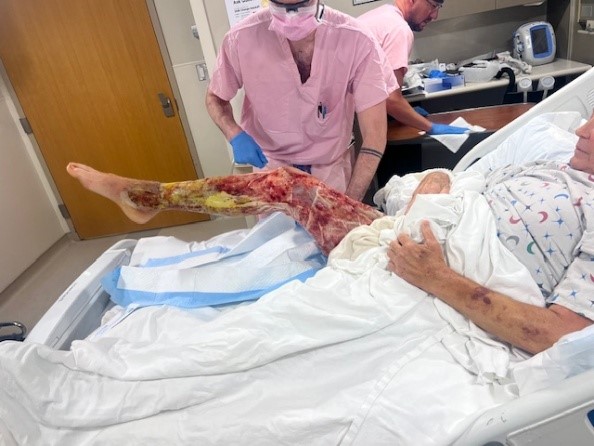
On July 6, a neighbor contracted a flesh-eating disease on Oyster Creek where Senator Winegrad lives, 75 yards from his pier. It started as a cut on his shin from tending a fish trap on his pier. The necrotizing infection cost him nearly all of the tissue on the front and back of one leg. He was close to having to decide whether to have his leg amputated or face death. Intensive antibiotic intravenous treatment and surgeries at our local hospital and then at Baltimore’s Shock Trauma center saved his life and leg (below).
See the detailed July 22 article Man Fights Flesh-eating Bacteria after Exposure at Annapolis Pieron on this and other infections quoting the Shock Trauma surgeon who worked to save his leg and life at: https://www.chesapeakebaymagazine.com/man-fights-flesh-eating-bacteria-after-exposure-at-annapolis-pier/ This specialist surgeon has stated she has seen more such infectious diseases this summer than ever before. Here is the victim’s leg under treatment to restore his flesh:
Another victim of the failure to retore the Bay was retired Navy Captain and Naval Academy graduate Ted McClanahan who died four days after contracting a Vibrio vulnificus infection after Severn River water contact. See his picture and story at: https://www.capitalgazette.com/2023/07/21/gerald-winegrad-our-environmental-sins-contribute-to-former-navy-captains-death-commentary/
How can anyone claim success in Bay restoration when these cases are proliferating and the look these victims and their families in the eye? Does anyone reading these words and the Draft think its commitments will do much to prevent these flesh-eating diseases and fishery collapses and remove 70% of the Bay’s waters from the impaired list?
This information should be in the Preamble of the Draft at p.5 or the Clean Water section at p.11. This issue should not be ignored as there are many other documented cases of such infections including watermen, one in Rock Hall who had his leg amputated.
HERE ARE OTHER SPECIFIC RECOMMENDATIONS TO BE INCLUDED IN THE DRAFT REVISED 2025 CHESAPEAKE BAY WATERSHED AGREEMENT.
IMPOSE SANCTIONS FOR FAILURE TO REDUCE N,P,S AS PRESCRIBED.
Previous agreements were voluntary while the TMDL was considered mandatory. EPA listed possible sanctions for non-compliant states that did not fully adopt or implement WIPs to achieve their TMDL Despite repeated failures by the states to honor their Bay Agreement commitments and the TMDL, no sanctions were imposed as more than 70% of bay waters are still impaired.
Critical commitments under the 2014 Bay Watershed Agreement were not met after 11 years with no sanctions.
The EPA and Bay states must agree that after four decades of failure to meet commitments, penalties will be imposed after 2030 and 2035 for not meeting deadlines on agreed-upon terms and reductions. Sanctions can range from withholding federal grants to blocking new discharge permits for new water and air emissions. See the December 29, 2009 letter of possible sanctions listed by then EPA Director of Region III, which we will provide if requested. Otherwise, this entire exercise will remain voluntary, dooming Bay restoration to failure.
MANDATE REQUIREMENTS FOR AGRICULTURAL POLLUTANT REDUCTIONS
The major reason for an impaired, polluted Chesapeake is the failure to curb agricultural nutrients and sediment, the largest source of N,P,S to the Chesapeake. Despite more than $2 billion in federal grants and hundreds of millions more in state dollars given to farmers to implement pollution reduction practices since 2010, there has been no measurable decline in farm nitrogen flows to the Bay and phosphorus reductions are grossly overestimated. Even at inflated estimates, the TMDL reductions for N have been missed by wide margins and the P reductions estimated appear to be exaggerated.
About 90% of planned future nitrogen reductions to meet state WIPs must come from agriculture, the Bay’s largest pollution source. The task has become much more difficult as agricultural intensification has added more fertilizer and farm animals and manure pollutants. Remarkably, the plan is devoid of measures to reduce agricultural pollutants, nor is this issue that is at the heart of the failure to achieve the TMDL and state WIPs even mentioned.
Further, reducing agricultural N,P,S is by far the most cost-effective way to reduce these Bay pollutants—no other N,P,S source can be reduced at a cheaper cost per pound than from agriculture.
A collaboration of more than 50 top Bay scientists warned in the 2023 CESR Report that throwing more money at farmers for voluntary measures has not and will not work well. They have suggested a pay-for-performance grant system whereby farmers receive cash only for implementing measures that are independently certified to reduce N,P,S.
See Karl Blankenship’s detailed columns on this ineffectiveness at: https://www.bayjournal.com/news/policy/scientists-ponder-how-well-are-ag-practices-helping-the-chesapeake-bay/article_59b8bda2-b957-11ee-9e45-83c79ce4dd2a.html and
The following commitments should be placed in the Draft’s Clean Water section at p.11:
All agricultural grants should be contingent on the effective implementation of best management practices under advanced nutrient management plans and payments made only upon independently certified reductions of N, P, or S. This is critical with repeated findings on the ineffectiveness of many BMPs voluntarily applied on farms. Intensive use of BMPs in small watershed have shown little if any reductions in nitrogen or phosphorus levels in streams. (See Blankenship’s columns cited above).
Manure from farm animals applied to land should be regulated in the same manner as advanced wastewater-treated biosolids under Maryland MDE regulations in effect since 1985. These include prohibiting the application on farm fields containing excess phosphorus, no winter applications and incorporation of manure into the soil by the end of the day or no later than 24 hours after application. See: Title 26, Maryland Department of Environment, Subtitle 04 Regulation of Water Supply, Sewage Disposal, and Solid Waste.
Regulations covering nutrient management plans and large animal feeding operations, including chicken growing facilities, should be fully enforced by on-site inspections by independent third-party entities.
Forested buffers of at least 100 feet should be required around all Bay and river waters adjoining farmland.
Ignoring agriculture’s major role in the Bay’s impaired waters and in the failure to meet TMDL caps should not be ignored in the Draft 2025 Watershed Agreement as it would be a fatal flaw. Pouring more money into voluntary BMPs has not and will not work to achieve water quality goals. Mandatory requirements are urgently required as with WWTPs.
INCREASE STREAM BUFFERS AND FOREST COVER.
The 2014 agreement dictated a critical goal of adding 900 miles per year of 100-foot forested buffers, first committed to under the 2000 Bay Agreement. And it also provided that the states were to “conserve existing buffers” until 70% of riparian areas were buffered. This is one of the most effective ways to reduce nutrient and sediment flows to our waters.
But the 900-mile annual goal has only been met once, in 2002, and often less than 10% of the annual goal has been achieved. The overall goal of 70% forested riparian areas will not be met any time in the near future as overall forested buffer acreage has declined since 2014.
The states put 190,557 acres of cumulative forest buffer implementation in their Phase III WIPs to be achieved by 2025. As of 2023, states had reported a cumulative total of 57,911 acres of forest buffers. This reflects a gap of 132,645 acres or 10,943 miles. Source: Bay Program’s Chesapeake Progress reporting tracking all 31 2014 Watershed Agreement Outcomes at: https://www.chesapeakeprogress.com/outcome-status
The Draft reduces the long-standing 900-mile buffer goal and instead has this:
Forest Buffers: Reduce the loss of existing buffers, and plant and maintain 7,500 acres of forest buffers annually to achieve no less than 71% riparian forest cover by 2035 and 75% riparian forest cover over the long-term.
The 7,500-acre goal is actually a reduction of the 900-mile, 100-foot buffer goal by 31% annually in acreage. The draft also does not call for conserving existing buffers, rather it simply calls for reducing the loss. This is unacceptable as forest buffers are crucial to Bay recovery.
The Draft should keep the critically important current annual 900-mile, 100-foot-wide riparian buffer goal and states should commit to meet it every year until 2035. The Draft should contain provisions that states enact laws to prohibit development of existing buffers up to at least 100 feet. This should be added under the Healthy Landscapes section, Healthy Forests and Trees at p.14.
The 2014 Agreement committed to continually increase urban tree canopy capacity to provide air quality; water quality and habitat benefits throughout the watershed and expand urban tree canopy by 2,400 acres by 2025. Instead, the latest land use/land cover change data shows a net loss of over 25,000 acres between 2013/14 and 2017/18, outpacing the gains from community tree plantings. The 11,340 acres planted so far are not enough to mitigate the losses. See: https://www.chesapeakeprogress.com/outcome-status The cited website notes that “Much greater effort is needed to reverse the trend of net losses and achieve the net gain specified in the outcome.”
However, the Draft states this: Tree Canopy: Reduce the loss of existing canopy, and plant and maintain 35,000 acres of community trees by 2035 to achieve a net gain in canopy over the long-term. Forest Conservation: Reduce the loss of existing forests to development through planning and conservation, and plant and maintain _XX_ acres of new forests by 2035 to achieve a net gain in forests over the long-term.
Sadly, this response to the major loss of tree canopy falls far short of the conservation of our forests needed for Bay recovery and for states to meet their WIPs. We recommend that:
States should act to prevent further loss of forest and enact no net loss of forest laws from development as the City of Annapolis did in 2012. See: https://library.municode.com/md/annapolis/codes/code_of_ordinances?nodeId=TIT21PLZO_DIVVREGEAP_CH21.71FOCO Since the Draft has no goal for increased forest cover, we recommend a goal of an increase of 10,000 net acres by 2030 and 25,000 by 2035.
At p.13 of the draft under Healthy Landscapes, the Draft has this:
Forests: By 2040, permanently protect a total of _XX_ acres of forest, of which XX% are in riparian areas.
We would suggest that the long-term goal should be to protect at least half of the Bay watershed’s 24 million acres of forest, including at least 85% of forest in riparian areas of 100 feet of the water.
These comments and recommendations should be in the Healthy Landscapes section at p.13.
RE-ESTABLISH GOALS FOR 85,000 NEW WETLAND ACRES AND ENHANCEMENT OF 150,000 ACRES.
The 2014 Chesapeake Bay Watershed Agreement committed the states to create or reestablish 85,000 acres of tidal and non-tidal wetlands and enhance the functioning of an additional 150,000 acres of degraded wetlands by 2025.
Between 2014 and 2022, 4,310 acres of wetlands were created or reestablished, 5% of the 85,000-acre goal. Only 60,666 acres of wetlands have been enhanced from 2014 to 2022, this represents 40% of the goal of 150,000-acre goal. https://www.chesapeakeprogress.com/outcome-status
With more than 70% of the Bay waters impaired and increasing loads of nutrients unaccounted for, the Draft greatly reduces these goals for wetland establishment and enhancement. Here is what is proposed:
Tidal Wetlands Target: Restore or create 1,000 acres and enhance 15,000 acres by 2035. • Non-Tidal Wetlands Target: Restore or create 2,000 acres and enhance 15,000 acres by 2035. The draft would reduce the 85,000-acre restoration or creation goal to a combined 3,000 acre and the 150,000-acre enhancement goal to 30,000.
These greatly reduced wetland goals should be reversed as wetlands are critical for Bay water quality and its wildlife and fisheries. Instead, we recommend that:
The 2014 wetland goals should be re-established as goals for the creation or re-establishment of 85,000 new wetland acres and the enhancement of 150,000 acres so that 50% of these goals are achieved by 2030 and 100% by 2035.
At p.13, Healthy Landscapes, this appears: Wetlands: By 2040, permanently protect a total of _XX_ acres of wetlands, focusing on the protection of buffer zones.
Since both tidal and non-tidal wetlands are protected under most state laws, this sentence should read: Ensure the protection of all tidal and non-tidal wetlands and at least 35-foot buffers using the definition of wetlands in Maryland law so that any disturbance authorized under permits is mitigated so there is no permitted net loss of wetlands.
Both of these changes should be under Thriving Habitat and Wildlife, Wetlands at p.10.
ADDRESS URBAN STORMWATER POLLUTION.
Nitrogen flowing from urban stormwater has increased since 2010, violating commitments in state WIPs for substantial reductions. But the Draft ignores this and the increasing stormwater pollution impacting the achievement of water quality goals and the TMDL from increased development and impervious surfaces. We recommend that this be added to the Clean Water section, p.11:
States should be required to meet their WIP plans on stormwater pollutant reductions by 2030 and enact laws that require no increases in rate, volume, or pollutant loads from all new development from a 25-year storm event.
INCREASE OYSTER POPULATION BY 10-FOLD
The Bay states committed in their 2000 Bay Agreement to achieve a 10-fold increase in Bay oyster biomass over 1994 levels by 2010. Instead, oysters declined. The 10-fold goal was abandoned in the 2014 Agreement. It should be reinstituted as oysters are a keystone species with significant water quality and habitat values. Oysters filter nutrients and sediment from Bay waters and oyster bars serve as the Bay’s coral reefs hosting many species of fish, blue crabs, and hundreds of other Bay organisms.
Despite an uptick in population, oysters are still a small fraction of historical levels, perhaps at 3% of the 1890 population. Researchers found that if harvest had ceased in the upper Chesapeake Bay in 1986, adult oyster abundance would have increased 15.8 times by 2009. Instead, it dropped by 92%. They called for a harvest moratorium. See Wilberg et al., Marine Ecology Progress Series, August 2011. Note that more than 95% of the world’s oysters are harvested in aquaculture operations.
The draft has very little in it to advance oyster populations, taking mainly a status quo posture except for this: Restore or conserve at least 1,800 additional acres of oyster reef habitat concentrated primarily in restoration focus areas to provide ecosystem service benefits.
The expenditure of more than $400 million in federal and state funds on oyster restoration has not come close to achieving what a closure of wild harvest and a shift to aquaculture would achieve. We recommend that this be included in the Oyster Section at p.9 of the Draft:
The states of Maryland and Virginia should phase out wild oyster harvests over a five-year period with compensation for oyster harvesters based on the last three years of harvest to help them shift to aquaculture. If they do not use the funds within two years on aquaculture operations, the funds would revert to other oyster harvesters.
ADDRESS CONOWINGO DAM FILLED RESERVOIR NUTRIENT AND SEDIMENT OVERFLOW.
The overflow from the build-up behind the Conowingo Dam is adding 6 million pounds of nitrogen to the Bay a year as well as sediment, both overflowing from the reservoir behind the dam. The nitrogen and sediment built up behind the dam has been accumulating since 1928.
The Bay Program has established a Conowingo WIP Steering Committee, but the Draft is silent on this issue. There has been an experimental removal of some of the sediment behind the dam and plans are being worked upon on a long-term solution under a resolution of Federal litigation.
The Draft should add a new item under the Clean Water section, p.11 that includes a commitment for the states and EPA to promote a comprehensive plan to remove nitrogen, phosphorus, and sediment from the reservoir in an environmentally sound way and properly dispose of it. This problem has existed for decades, and the Draft should dictate that a solution should be agreed upon for a plan to be developed by the end of 2026.
GLOBAL WARMING MUST BE ADDRESSED
All references to climate change and global warming are excised from the agreement despite coverage in the 2014 agreement. Such warming adds an additional 5 million pounds of nitrogen annually and cannot be ignored as the Bay’s wetlands, intertidal grasses, and living resources are affected.
More powerful and frequent storms increase water pollution from runoff and stream erosion. Higher temperatures put species at risk, deplete oxygen, and reduce some submerged Bay grasses. Rising sea levels cause flooding, erosion. and destruction of inter-tidal grasses as at Senator Winegard’s home on Oyster Creek where all inter-tidal grasses have died from sea level rise over 27 years.
By 2055, climate-related nitrogen increases are projected to be four times greater than during the last 30 years. Climate change must be forcefully addressed. Here is our suggestion:
Since climate change threatens Bay restoration, including by adding 5 million pounds of nitrogen annually to the Bay, the Bay states commit to adopting and implementing plans to significantly reduce their emissions of global warming gases and to plan for resiliency to prevent erosion, loss of wetland vegetation, and damage to important infrastructure.
| Gerald W. Winegrad, Former Maryland State Senator
1328 Washington Drive Annapolis, MD 21403
|
Frederick L. Tutman, Patuxent Riverkeeper
Patuxent Riverkeeper Center 17412 Nottingham Road Upper Marlboro, MD 20772
|