DECLINE OF UNDERWATER GRASSES IMPEDES BAY RESTORATION | COMMENTARY
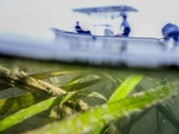
Bay grass annual survey conducted by Virginia Institute of Marine Science showed another decline in this critical submerged vegetation. These plants, like this eelgrass, serve as an indicator of overall Bay health. (Alyson Hall, VIMS)
August 22, 2025 By Gerald Winegrad:
Underwater grasses, termed submerged aquatic vegetation (SAV), are the Chesapeake Bay’s unsung heroes among its living resources. Oysters grab the spotlight because of their economic value and water filtering capacity while our iconic blue crabs are Most Valuable Players gastronomically, economically and in our psyche. But SAV’s critical role in the Chesapeake’s ecological integrity is underappreciated.
News this month that SAV declined overall and is far from meeting healthy goals has been met with a collective yawn. So why make a big deal over these plants that can thrive in the shallow waters of the bay and her labyrinth of creeks and rivers?
The 18 SAV species perform critical functions for the bay system. They serve as aquatic forests providing essential habitat for many bay critters to hide, feed and reproduce, sheltering in these waving grasses. SAV beneficiaries include blue crabs, rockfish, seahorses, sea turtles, waterfowl and tiny crustaceans that are essential elements of the bay’s food chain.
Juvenile and shedding crabs hide from predators in SAV forests, which provide a wide array of smaller critters that serve as crab food. Biologists have found from five to 30 times more juvenile crabs in SAV beds than in adjacent unvegetated bay bottom.
I have been in the shallow waters of Smith Island, thick with grasses, with a soft crabber on his low-rise wooden boat. Two, four-foot crab scrapes claw the bottom for crabs, one port side and one starboard side. The crabber hauls in the heavy, large balls of grass by hand with soft crabs, peelers and hard crabs within to be sorted. The rake does not pull up the roots.
The molting crabs seek protective shelter in the SAV as they turn soft after shedding, escaping fish and other predators. Smith Island is the bay’s soft crab capital, once home to the largest soft crabbing industry in the country. The diversity of aquatic life I saw in the dredge nets was remarkable, including sea horses, white shrimp, juvenile rockfish and even a cownose ray.
The decline of SAV is a major blow to crab populations, with data showing blue crabs reduced to their second-lowest numbers since surveys began in 1990. From 2012 to 2022, Maryland’s soft crab harvest was reduced by 59%; hard crab harvest by 45%. Current harvest pressure is unsustainable, and SAV restoration is paramount, along with greater harvest restrictions, to a thriving crab population.
SAV also provides valuable water quality benefits, helping keep it clear for sunlight penetration and healthy by absorbing nutrients and toxic chemicals. Bay grasses also trap sediment, reduce acidity, prevent shoreline erosion, provide oxygen and act as a carbon sink absorbing carbon dioxide.
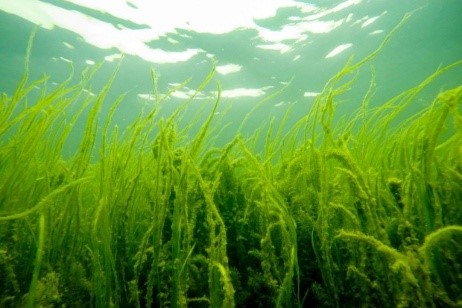
Wild celery is vital to the bay ecosystem as a crucial food source for waterfowl, as habitat for many other species, and as an absorber of nitrogen and phosphorus limiting the growth of harmful algae that blocks sunlight needed by other SAV. Underwater grass restoration is a key component of the bay’s overall health and continued recovery. (Will Parson/Chesapeake Bay Program)
Sago pondweed, an SAV species, is considered one of the most valuable food sources for waterfowl in North America. Redhead grass is named for the redhead ducks found feeding on it. Wild celery’s scientific name derives from canvasback ducks. Eelgrass also provides waterfowl food and, along with widgeon grass, is a dominant SAV species around Smith Island.
Scientists consider the amount of bay SAV coverage a key health indicator because SAV responds quickly to water quality improvements. Sadly, SAV acreage indicates how far behind we are in restoring the bay’s water quality. Under the 2000 Bay Agreement, bay state governors committed to restoring the bay’s SAV to 185,000 acres by 2010. The 2024 SAV survey for the bay released earlier this month showed SAV coverage was down 1% to 82,778 acres or only 45% of the goal set for 2010.
To put all of this in long-term perspective, the seagrass experts at VIMS estimate that at its most pristine, the Chesapeake Bay may have supported more than 600,000 acres of underwater grasses.
Despite never coming close to the 185,000-acre goal, what did our fearless leaders do? Instead of acting to curb the excess flow of nutrients and sediment from farms and developed lands impacting grasses, in 2014, they lowered the goal to 90,000 acres by 2017 and 130,000 acres by 2025. Neither goal was attained.
The new draft 2025 Bay Agreement drowns many goals in a polluted bay of broken promises. It tragically proposes a new interim goal of 95,000 acres by 2035. See my column on this farcical draft.
The new SAV survey did find seagrass meadows reaching record-breaking gains in saltier bay regions, but they were offset by mid-bay losses around our area and across the bay on the Eastern Shore. In Anne Arundel County rivers, the Severn had 134 acres, down from 295 acres in 2020 and well short of its 455-acre goal.
The combined acreage for the South, Rhode and West Rivers was 0.12 acres with their target at 777 acres. The Magothy had 128 acres, well short of its goal of 579 acres. Substantial losses occurred in Eastern Bay (-36%), Choptank River mouth (-41%), Little Choptank River (-83%), Fishing Bay (-83%) and Tangier Sound (-8%), where Smith Island is located. Maryland SAV declined overall to 36,794 acres, less than half of its goal of 79,800 acres by 2025.
Remarkably, Maryland DNR’s Brooke Landry, their SAV program chief and chair of the Bay Program’s SAV Workgroup, touted the SAV data with the greenwashing that pervades bay restoration: “Despite many environmental pressures on the Bay, we continue to see signs of resilience and recovery in our underwater grasses. The increases in SAV acres observed in three of the four salinity zones this year are truly a testament to the effectiveness of long-term nutrient reductions and collaborative restoration efforts.” Really?
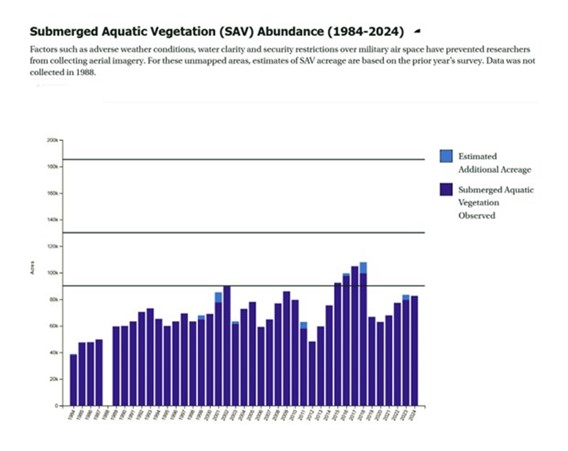
This Bay Program chart documents how SAV recovery, a key indicator of bay health, has failed to come close to the 185,000-acre goal set in 2000 with the top line representing this goal. Instead of stemming farm and development pollution, bay leaders greatly reduced the goal and failed to meet it. (Chesapeake Bay Program)
So, what needs to be done? Robert Orth, the retired Virginia Institute of Marine Science scientist and SAV guru, noted that “underwater grasses are flowering plants that need more light than any other plants on Earth.” Sunlight is crucial for photosynthesis, the process by which these plants produce their own food.
But for more than a century, these plants have had to deal with reduced sunlight from nutrient pollution fueling algae blooms and from sediment runoff. In addition, excess nutrients fuel epiphytic growth on the plants that can block sunlight and smother them.
The major source of these bay-choking pollutants is agriculture, which is the least regulated of all bay pollutants. Flows from land development stormwater are also an increasing problem. As I have repeatedly detailed, bold new laws and regulations must be enacted to curb both of these pollution sources.
When I was a young teenager, what we called seaweed thrived in this area. One hot summer day, I went out on my friend’s boat from Spa Creek. The seaweed was so thick on the Severn, it sheared the outboard motor’s cotter pin, losing the propeller. We were dead in the water in the middle of a huge SAV bed. We waded to shore at Round Bay, where a woman allowed us to call my friend’s dad. We were slowly towed back to Annapolis by his father and a friend. It was not a pleasant boat ride.
Unless our feckless leaders act, we will never see the thick seaweed beds of my youth again nor super-abundant crabs. It is no coincidence that crab numbers have plummeted concurrently with SAV declines.
Gerald Winegrad represented the greater Annapolis area as a Democrat in the Maryland House of Delegates and Senate for 16 years. Contact him at gwwabc@comcast.net.