GERALD WINEGRAD: DON’T FEAR THE REMARKABLE ALLIGATOR | COMMENTARY
By Gerald Winegrad,
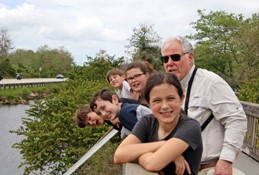
Gerald with his 3 grandkids and their 2 friends counting alligators at the Oasis Visitor Center in the Big Cypress National Preserve with vehicles speeding by on US 41. Does this look like treacherous swampland slithering with serpents and alligators? (Carol Swan/Courtesy)
The recent worldwide attention on the U.S. locking up immigrants at the newly ordained “Alligator Alcatraz” facility has centered on the controversy around its construction in a protected natural area with its legality being challenged in court, the arrest and incarceration of immigrants with no criminal records, and the conditions within the facility.
This facility is holding 3,000 immigrants and could be used as a blueprint as the federal government expands locations to hold immigrants facing deportation. This is despite the cost: Florida billing the U.S. $450 million for its construction and operation for one year.
I have another concern over the falsehoods and mischaracterizations concerning the American alligator, the only crocodilian confined to the United States. The “Jaws” movie propelled a worldwide shark-killing frenzy, which is why I will never watch it. I write to dispel the alligator falsehoods and their depictions as vicious killers. This is linked to my lifelong fascination with crocodilians, and this alligator is the species with which I have the greatest experience.
The prison facility consists of tents and trailers holding cages built on an abandoned jet airport, surrounded by the 729,000-acre Big Cypress National Preserve in the Everglades ecosystem. Before his visit on July 1, President Trump proudly inflamed the myth of alligators being vicious people-eaters, telling reporters that alligators and snakes would attack anyone trying to get out. During the tour, he joked about “a lot of cops that are in the form of alligators” at the facility.
Sights & Sounds: Allegiant Stadium Open Practice
While touring the makeshift facility, Trump opined that “even the most hardened of killers would have a hell of a time making it out of Alligator Alcatraz alive. We’re surrounded by miles of treacherous swampland.” He also described the locale as slithering with serpents and alligators. “We’re going to teach them how to run away from an alligator if they escape prison,” he said sarcastically. “Don’t run in a straight line.”
Trump’s new deputy press secretary, Abigail Jackson, put out an AI-generated video of alligators wearing Immigration and Customs Enforcement hats while dancing to Vanilla Ice’s “Ice Ice Baby.”
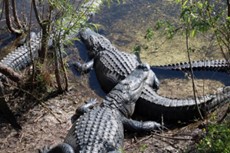
Alligators in Big Cypress National Preserve. These remarkable animals pose no threat to humans if left alone and are important to ecological integrity. (Carol Swan/Courtesy)
I am quite familiar with the Big Cypress National Preserve and Everglades National Park, as my wife and I have visited many times. We have ridden by the jet park site on long dirt roads. There is no treacherous swampland. There are productive wetlands with plenty of fast lands and a few dirt roads.
Carol and I have been birdwatching in the Preserve and looking for gators, snakes and the critically endangered Florida panther, rarely seen as it has been reduced to 230 adults in all of Florida. We saw gators and a few snakes and turtles and a good number of birds, but no panthers or invasive pythons. The gators were all in or next to the water seen from the road, basking peacefully.
The greatest danger we experienced was trucks barreling at high speed toward us, dirt flying. Our youngest daughter and three grandkids live in Naples, 35 miles from the Preserve. The kiddies and their friends travel with us on these wildlife trips including touring Everglades National Park at Shark Valley where we see many alligators on foot near the trails and on bike rides.
Alligators have thrived for thousands of years in the Everglades system, elsewhere in Florida and in other southeastern states, especially Louisiana. Their lineage goes back 200 million years. But they barely survived the wanton slaughter of perhaps 8 million and habitat destruction wrought by humans over the centuries. After being reduced to 200 animals, their listing as endangered species sparked a comeback where they now number 5 million, 1.3 million in Florida.
These predators are an ecologically important species that enthralls my sense of wonderment as I consider alligators and all crocodilians as among nature’s most perfect creatures. Let’s dispel the myths about gators and threats to humans.
I have been around and very close to wild alligators for decades. If you respect them, do nothing to disturb or provoke them, and keep a safe distance, the likelihood of an attack is extremely unlikely. I have never experienced any aggression toward me, my wife or my grandchildren.
They are remarkable and can move quickly in bursts. I have seen a gator propel itself with its powerful tail 5 feet out of the water to snap at a great blue heron who barely avoided capture. I witnessed a great egret land near a momma gator’s young with the momma thrusting herself towards the egret like a lightning bolt but just missing a meal.
Professor James Fourqurean of Florida International University, an expert on the Everglades, dispelled Trump’s supposition that alligators and pythons posed any threats to prisoners. Yes, alligators have attacked people and killed them, but it is extremely rare.
Florida has 24 million people, many of whom live on previous or current alligator habitat or visit such areas. The Centers for Disease Control and Prevention (CDC) data records that gators killed 10 people in all of the U.S. between 1999 and 2019. During this period, the CDC reported five times as many people died after being mauled by dogs and 12 times as many were struck by lightning.
Another study published in the peer-reviewed academic journal Wilderness & Environmental Medicine goes back much further. It recorded just 376 injuries and 23 deaths between 1948 and August 2004, amounting to just one death every three to four years. Most of these cases were in Florida. Compare 23 deaths from alligators over 56 years to 41,840 murders by humans in 25 years in Florida from 2000 through 2024, including 1,473 in 2024.
Dr. Joseph Forrester, a Stanford University surgeon, found that “the most common animal-related fatalities are from large mammals, like cattle or horses, but when you’re looking at attacks from wild animals only, the most common causes of death are due to venomous animals, like wasps or bees.”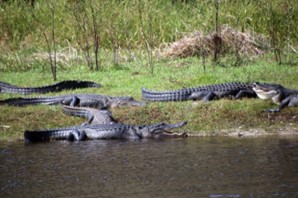
Alligators are ectothermic, relying on external sources of heat to regulate their body temperature. Here they control body temperature by basking in the sun. They are most active when temperatures are between 82° to 92°, stop feeding when it’s below 70° F, and become dormant below 55° F. They release heat by opening their mouths. (Carol Swan/Courtesy)
In my many eco-trips around the world, the creatures of most concern to me, particularly in the tropics and subtropics, are the smallest — bullet ants, army ants, mosquitoes and tsetse flies. The only exception is hiking in Alaska and Montana, where grizzly bears are present.
The American alligator, one of 26 crocodilians, is found throughout the southeastern states from Florida to North Carolina and west to Texas and have been seen in Arkansas and Oklahoma. Its cousin, the American crocodile, is found only in South Florida in the U.S. and in Cuba, Jamaica and Hispaniola, and the coasts of Mexico to as far south as Peru. I have seen them in Florida and many in Costa Rica.
It seems to me that the threat of gators and snakes pales into nothingness compared to the threat to our democracy and the rule of law by the cruel arrests by masked ICE agents, the imprisonment and mistreatment of immigrants in the remote jail, and the fact that most detainees do not have any U.S. criminal records. The vicious joy celebrated by Trump and his sycophants warps any sense of justice.
Next week’s column will expand on my fascination with American alligators and crocodiles as well as on some of the other crocodilian family — the Chinese alligator, other crocodiles, caimans and gharials.
Gerald Winegrad represented the greater Annapolis area as a Democrat in the Maryland House of Delegates and Senate for 16 years. Contact him at gwwabc@comcast.net.