GERALD WINEGRAD: FOREST DESTRUCTION STILL THRIVES IN BAY REGION | COMMENTARY
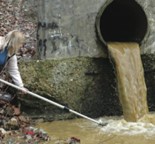
Forest clearing facilitates grossly polluted stormwater running from impervious surfaces from tens of thousands of such outlets, this one polluting the South River in Anne Arundel County. (Courtesy Diana Muller)
By Gerald Winegrad,
More than 50 years ago, I realized that if we were to be successful in restoring the Chesapeake Bay, it was absolutely critical that we preserve, and ultimately increase, its forest. The urgency of conserving and enhancing forest cover, especially of forested buffers directly on the water (riparian forests), is of paramount importance. That’s why I developed, sponsored and managed to pass the Maryland Forest Conservation Act in 1991 to better protect forests from development. The law has slowed development of forest from land development, but significant losses still occur as counties and cities often apply its terms to be most favorable to developers.
So why are forests so essential?
Forests act like giant sponges, stabilizing soils and greatly reducing stormwater runoff into streams and the bay. The extensive system of trees, understory growth, leaves and detritus absorbs up to 90% of nutrients, sediment and toxic chemicals, keeping them from affecting waterways.
Nature’s natural drainage system allows stormwater to slowly percolate into groundwater. During a 1-inch rainfall, a 1-acre forest releases 750 gallons of runoff; an impervious parking lot releases 27,000 gallons! Forests break the erosive impact of rainfall with mature trees having deep root systems that hold soil in place, stabilizing stream banks and preventing erosion from smothering streams with sediment.
Forests also serve as nature’s flood-control system. As pollutants are filtered out, the retained water replenishes underlying aquifers instead of running off where downstream flooding can occur. These underground aquifers supply most of our water. Some aquifers have been drawn down because forest loss no longer allows their replenishment. Wells must be drilled deeper to reach underlying aquifers because of the drawdowns and saltwater intrusion. This has occurred on the Annapolis Neck Peninsula, costing homeowners and businesses thousands of dollars.
One forest acre absorbs six tons of carbon dioxide, the main global warming gas, and produces four tons of oxygen. Tree cover lowers summertime water temperatures with these cooler waters vital to spawning trout and other aquatic species. Woodlands provide habitat and food for many critters including avian species that breed, nest and roost in large forest tracts. Leaf litter and other forest materials fall into streams and form the foundation of freshwater food chains vital to fish and other aquatic species.
Forests provide us with places where we can reflect and experience natural beauty and solitude. Exposure to forests strengthens our immune system, reduces blood pressure, increases energy, boosts our mood and helps us regain and maintain our focus in ways that treeless environments don’t. The Japanese call it “forest bathing.” Even 20 minutes in a forest is enough to produce positive change.
Forests foster outdoor recreation through activities like hiking, biking, camping and birdwatching, and increase property values and lower residential and commercial energy use. They generate billions of dollars annually by supplying wood and paper products. Forestry is Maryland’s fifth-largest industry.
When forests are destroyed and fragmented by development, agriculture and timbering, their ecological services and economic benefits may be lost if timbered land is not reforested or allowed to regenerate. The EPA-led Bay Program and scientists connected with bay restoration have recognized the incredible importance of forests to a healthy bay, especially streamside forested buffers.
Colonization triggered an ecological armageddon with massive deforestation for timber, fuel, crops, farm animals and development. Over 416 years of expansion and rapacious development, forest cover in the continental U.S. has been reduced to 34% while in Maryland it has declined to 39%. Virginia, the other major bay state, has about 62% of its forest left. The destruction continues.
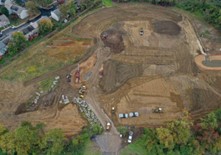
The 2014 destruction of 9 acres of forest for housing at Rocky Gorge, now Athens, along Aris T. Allen Boulevard in Annapolis counted in the loss of 18,891 Maryland forest acres from
The 2014 destruction of 9 acres of forest for housing at Rocky Gorge, now Athens, along Aris T. Allen Boulevard in Annapolis counted in the loss of 18,891 Maryland forest acres from development 2014-2022. The property still sits idle as a reminder of the bad old days before enactment of the City’s model net loss law in 1918. (Jeffrey F. Bill/Staff)
A new authoritative aerial study of forest and tree canopy cover in the bay watershed brings depressing news: Deforestation continues. In the eight years preceding 2022, 176,845 acres were lost to development, timbering, agriculture and other human activities. Tree plantings and forest regeneration left the actual net loss of forest at 104,000 acres. Maryland accounted for 18,821 acres of net forest loss. Anne Arundel County lost 1,426 acres of tree canopy.
The bay states failed grossly to honor their pledge to increase tree canopy by 2,400 acres by 2025, but canopy dropped by a net of 29,908 acres. Canopy is a different measure that includes some forests. Maryland and Virginia led the assault on trees, accounting for 82% of this canopy loss, 11,867 acres and 11,873 acres, respectively.
The net loss of forested riparian buffers of 41,941 acres was alarming as these 100-foot buffers are one of the best and cheapest ways to improve water quality. This is why the bay states committed in 2000 to restore 900 miles per year. Tragically for the bay, this 900-acre goal was achieved only once, in 2002, while states often achieved less than 10% of the annual commitment. As of 2025, only 29% of the 900-mile-per-year target has been met.
Of the 227 miles of forest buffers restored in 2024 (25% of the commitment), only 13 miles were reported in Maryland. The overall loss of forest and stream buffers defines the collapse of bay restoration priorities, especially in Maryland and Virginia. While tree plantings flourish, notably in Maryland as a politically safe measure, forests are being cleared at a much greater rate.
Exacerbating this jarring news is the increase in impervious surfaces from development. Development took out more than 128,000 acres of forest and converted it to 103,000 acres of impervious surface in the eight years through 2021. Maryland now has the greatest percentage of impervious coverage per land mass of the bay states.
Pavement and buildings have long been covering the bay watershed faster than its population has been growing. From 1990 to 2007, impervious surfaces associated with single-family homes increased by about 34% while the population increased by 18%.
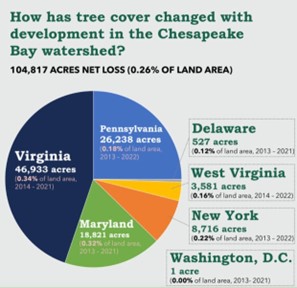
The significant loss of Chesapeake forests from development continues impeding restoration and adding millions of tons of bay-choking pollutants. (State of Chesapeake Forests Data 2013-2021)
This leaves a bay full of broken promises as Maryland and Virginia fail to meet their moderate commitments, work to weaken them in the new Bay Agreement under consideration, and fail to enact a no net loss of forest in development law as Annapolis did.
Annapolis is one of the few towns to gain tree canopy during the study period, gaining 13 acres. Salisbury was the leader in this limited and unique club with a gain of 31 acres linked to $400,000 from Perdue from a court settlement of an air pollution case and a $150,000 grant from the Chesapeake Bay Trust, both to plant trees.
In addition to development, forest loss is driven by timber harvesting as the aerial surveys identified clearing of more than 500,000 acres in the watershed from 2013 to 2021. But this loss was greatly reduced to 77,955 acres by replanting and regenerating. Agriculture took down a net of 33,111 acres of forest to grow crops and animals.
We are rapidly moving backward in destroying forest cover, especially along streams. The bay cannot be restored without restoring our forest and curbing agricultural pollutants. Next week’s column will suggest remedies. You can act now to plant trees, especially in riparian buffers.
Gerald Winegrad represented the greater Annapolis area as a Democrat in the Maryland House of Delegates and Senate for 16 years. Contact him at gwwabc@comcast.net.
Lay your eyes upon the legislation and regulations “I” developed, and witness my subsequent complaints about how the legislation never worked as promised!