GERALD WINEGRAD: HELP SAVE OSPREY CHICKS FROM STARVING | COMMENTARY
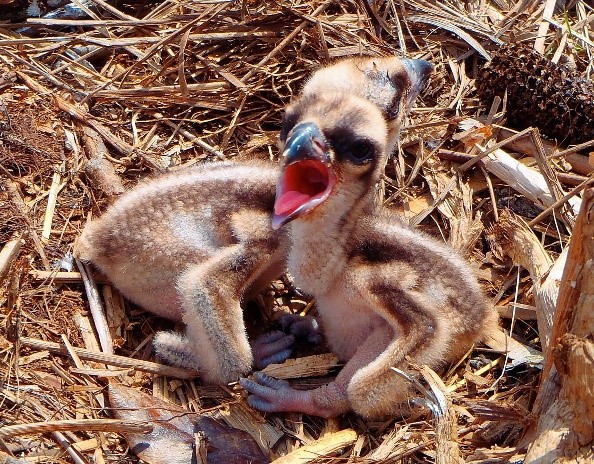
Osprey chicks are dying by the thousands from the decline in menhaden, writes Gerald Winegrad, threatening a substantial decline of 14% of the osprey population annually. Menhaden harvest for a Virginia rendering plant is the culprit. (USGS)
Your support is urgently needed for long-overdue major restrictions on the Virginia-based slaughter of tens of millions of individual menhaden a year. Thousands of osprey chicks in higher-salinity waters of bay country are dying slow, horrible deaths from starvation because of corporate greed decimating the ospreys’ major food supply — the Atlantic menhaden (also called alewife or bunker).
These oily calorie- and protein-dense forage fish are the major food for adult and young ospreys in tidal bay reaches.
Hearings are set along the Atlantic coast for the public to weigh in on whether to greatly reduce the huge harvest of menhaden in the Chesapeake by as much as 50% and to spread that harvest more evenly throughout the fishing season to allow enough summer menhaden for ospreys, other birds and fish.
Virginia allows large commercial ocean purse seine vessels using high-capacity netting techniques to scoop up entire schools of menhaden in the water after scout planes find the schools and smaller vessels circle the fish in vast nets. Maryland banned such harvest techniques more than 50 years ago. Omega Protein’s contracted fleet has been known to exceed its quota. Virginia is the only state along the Atlantic coast that still permits such an industrial reduction fishery, located in Reedville, Virginia.
The reduction facility processes the whole fish by cooking, pressing and separating them into fish meal, used as high-protein feed for aquaculture (farmed fish) and livestock. Menhaden are rich in Omega-3 fatty acids and used in human dietary supplements. Cooke Inc. of Canada purchased the U.S.-based Omega Protein in 2017 for $500 million. Cooke operates as a fully integrated global seafood and aquaculture corporation that controls every stage of production from freshwater hatcheries to consumer distribution, including for Atlantic salmon.
The Atlantic States Marine Fisheries Commission (ASMFC), a 13-state coastal interstate body that regulates near-shore fishing for migratory species, has been under pressure to end or greatly reduce this industrial harvest for decades. Omega Protein and Virginia have done all in their power to block any tighter regulations by the ASMFC or the state. Their governors and elected officials, both Republicans and Democrats, have been plied with hundreds of thousands of dollars in campaign donations over the last 20 years. Even legislation to study the Chesapeake menhaden population had been blocked by the Virginia legislature.
In August, the ASMFC finally voted to “consider” whether to adopt meaningful reductions, including up to a maximum of a 50% cut. This vote will take place at its November meeting after hearing from the public. This does not mean they will do anything to change the current harvest cap of 51,000 metric tons. That equates to roughly 112.4 million pounds of fish or about 150 million fish.
But we all have a chance to weigh in and force the ASMFC to act. Your opportunity comes from 6 p.m. to 8 p.m. this Tuesday, Sept. 15, at the Annapolis High School Auditorium. The Maryland Department of Natural Resources and the Potomac River Fisheries Commission will host.
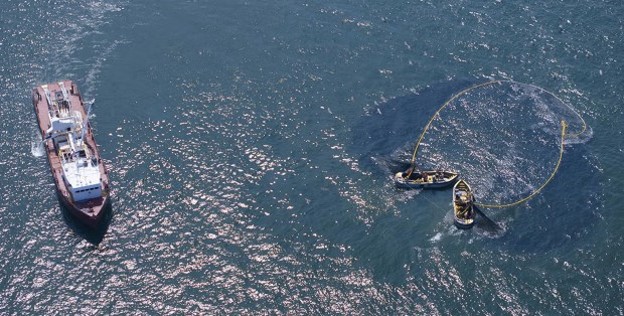
The harvest of tens of millions of menhaden is threatening osprey and other species dependent on this oily, protein dense fish. Chesapeake Bay Foundation calls this new evidence of a crises. (TRCP/CosmoVision Media)
DNR supports the ASMFC’s Draft Addendum II to the Menhaden Fishery Management Plan that would reduce the Chesapeake’s menhaden reduction fishery by up to 50% and spread the harvest more evenly across the season. This also addresses concerns about a 60% decline in the much smaller pound net harvest by bait harvesters, mostly for catching crabs.
Maryland’s top delegates to the ASMFC had argued in 2025 and 2026 that menhaden were all but absent from Maryland’s upper Chesapeake Bay, blaming Virginia’s intensive rendition harvest.
Many conservationists, including me, believe the best course is to apply the conservative precautionary principle to menhaden harvest and shut down the rendition fishery completely until a stock assessment is completed of the Chesapeake population. Then, only if the numbers clearly support such an industrial harvest, limit it accordingly. The ASMFC and Virginia have been blocking such stock assessments for more than a decade under the withering pressure of Omega Protein and its Ocean Harvesters.
In June, Gov. Abigail Spanberger intervened directly in the state budget process, bypassing traditional legislative roadblocks. She attached a budget amendment allocating $2 million to William & Mary’s Virginia Institute of Marine Science for a two-year study to establish a sound Virginia harvest cap for menhaden. This long-awaited two-year study should not be used as an excuse to maintain the status quo.
Other fish species using menhaden as a forage fish of ASMFC conservation concern include rockfish (overfished), bluefish (rebuilding), weakfish (depleted) and spiny dogfish (reproduction declining).
The cruelest, most disturbing aspect of menhaden overharvest in the bay and offshore is the collapse in osprey reproduction linked to the shortage. For osprey nesting in the bay’s tidal reaches with 5 ppt of salinity or above, fledging success has dropped to a frightening low of 0.25 per nesting pair, which is well below the ideal replacement level of 1.15 and lower than the worst years of DDT in the 1960s.
This data is from biologists surveying more than 900 nesting pairs and reflects a drop from 0.5 to 0.35 to 0.25 in the last three years. This equates to an alarming osprey decline of 14% a year, as 70% of nesting birds are affected. Similar declines are being observed in Delaware, New Jersey, Connecticut and Massachusetts. Some adult ospreys are avoiding nesting and mating. Localized reproductive declines were observed as long ago as the early 2000s.
A prime nest on my creek close to the bay has had nesting ospreys for 28 consecutive years since our moving to Oyster Creek. But this year, none nested. This failure to nest is being observed elsewhere. And last year, our nesting pair produced no young fledglings.
Every spring, we rejoice in the arrival of ospreys from their winter homes in South America. September signals their migratory return to the south, and soon, the skies will be devoid of these elegant flying machines with six-foot wingspans. Fish compose 99% of their diet, so they must migrate to ensure a winter supply.
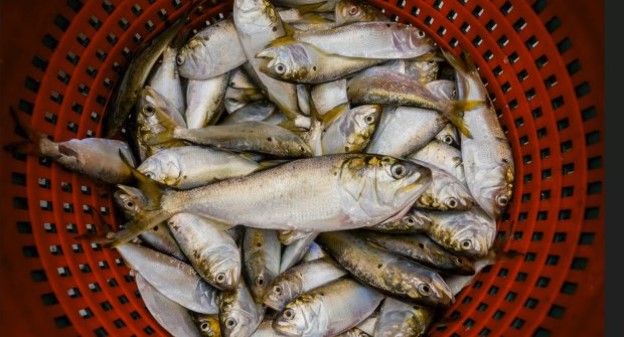
Menhaden have been termed the most important fish in the sea because of their keystone role in the food chain. Virginia is allowing a huge harvest disturbing the web of life. (Will Poston, CBF)
The osprey symbolized how human depredations against wildlife can be reversed, giving us a glimpse of hope. They were nearly wiped out by the widespread use of DDT, causing egg thinning and the death of young birds. When DDT was banned in 1972, only 1,450 breeding pairs were left in bay country.
This ban, coupled with U.S. law protection from shooting and nest destruction and the erection of nesting platforms, resulted in the population reaching more than 10,000 pairs in the bay region. This full recovery, perhaps to pre-colonial levels, left us with the highest osprey population in the world, a great success story!
But now, the sickening decline in reproduction may bring on another collapse and a different Silent Spring, free from the osprey’s unique whistling calls.
Please plan to attend the Sept. 15 event at Annapolis High School and speak out for ospreys, other bay critters and our important but humble star, the menhaden. Support a closure of the rendition harvest or at least a 50% harvest cut for 2027, as well as spacing harvest equally over May through November.
You may submit written comments by Oct. 10 at asmfc.org/actions/atlantic-menhaden-draft-addendum-ii or by email at comments@asmfc.org (subject line: Atlantic Menhaden Draft Addendum II)
Gerald Winegrad represented the greater Annapolis area as a Democrat in the Maryland House of Delegates and Senate for 16 years. Contact him at gwwabc@comcast.net.