GERALD WINEGRAD: NATURE IS THE BEST PRESCRIPTION FOR HEALTH AND LONGEVITY | COMMENTARY
As we plunge into the New Year enveloped in grey wintry weather and heightened socio-economic and political stress, let us seek relief in nature, a cure-all for distress, anxiety and depression.
Evidence of the need for this natural balm is everywhere. Suicide is a major national public health problem with U.S. suicide rates among the highest of wealthy nations. In 2024, the U.S. suicide rate was 15.6 per 100,000 people, 26th highest of 183 countries and well above the world average of 9.2. By comparison, our neighboring nation of Mexico is at 7 and Canada has a 9.4 rate.
We spend $15,000 per capita on health care, significantly more than any other nation, including all other wealthy ones. This is 50% more than #2 Switzerland and double what other high-income countries like Germany spend. And yet we are achieving lower health outcomes, including life expectancy.
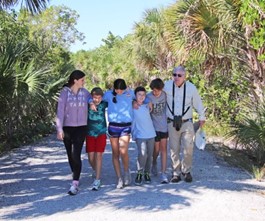
Gerald with his 3 grandkids and their 2 friends on a nature trail through forest at J.N. “Ding” Darling National Wildlife Refuge on Sanibel Island, FL. (Carol Swan/Courtesy)
In the 1950s and 1960s, Americans lived longer than many in advanced economies. But by 2019, Americans lived four years less than citizens of comparable nations. While U.S. life expectancy has recently recovered to pre-pandemic levels of 79.6 years, it dropped to 48th in the world, just below Panama and Albania. Our life expectancy remains well below that of wealthy nations such as Japan (85) and South Korea, Switzerland, Australia, Italy and Spain — all of which are at 84 years or greater.
Also troubling is the U.S. falling to 24th place in the 2025 World Happiness Report, its lowest ranking since the report’s 2012 inception. Experts attribute this drop to rising political polarization and a lack of social connection. The Wellbeing Research Centre at the University of Oxford ranks 147 nations. Costa Rica was #6, Mexico #10 and Canada #18.
The six key variables used to derive happiness scores include GDP per capita (living standards), social support (having someone to rely on), life expectancy, freedom to make life choices, generosity (charitable donations/helping behavior) and perceptions of corruption.
We must ask why we have high suicide rates and fall short on longevity and happiness when our GDP per capita is $89,599, higher than all but seven countries. The Peterson-KFF Health System Tracker attributes lower longevity despite the highest per capita medical spending to high costs for medical services and drugs, along with social and lifestyle factors like obesity, violence, opioid abuse, income inequality, poor environmental conditions and uneven health care access.
According to the nonpartisan Congressional Budget Office, Trump’s “One Big Beautiful Bill,” combined with other related policy changes, will result in 17 million people losing their health insurance.
Mental health providers in 2025 reported an uptick in demand for services related to political discord, leading to significant impacts on people’s health from stress, anxiety, sleep loss and obsessive thoughts. Some clinicians have noted these issues are related to President Donald Trump and the coarse, polarized political climate. Constant media consumption and “doom-scrolling” increase the odds of developing depression and anxiety symptoms. Around 5% of Americans have reported contemplating suicide due to the political climate.
These are trying times with our democracy under the greatest threat since the Civil War, which ended more than 160 years ago.
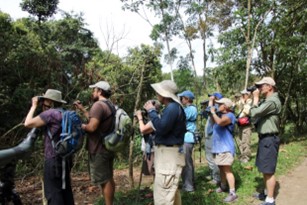
Gerald in forefront with a group he put together for an Eco-trip to Costa Rica where they spotted 400 avian species and sloths, monkeys, and American crocodiles. Fly SW Airlines non-stop and book with an excellent eco-tourism company with knowledgeable guides for an amazing and easy adventure. (Carol Swan/Courtesy)
This brings me back to the urgency of seeking comfort and solace in nature. The U.S. lifestyle has become detached from nature, and for many, from regular social contact. The average American spends nearly 90% of their time indoors.
Mounting medical evidence clearly documents how exposure to nature can lead to better health, including reduced risk of mental illness, depression, type 2 diabetes, cardiovascular disease, high blood pressure and premature death. Outdoor time for children fosters curiosity and independence, improves cognition, mood, self-esteem and social skills, and can make them physically healthier and less anxious.
This does not mean you must travel to hike and raft the Grand Canyon or look for alligators in Florida marshes. Outdoor opportunities surround you. Even if your community where you live does not have forested areas, walking trails or waterfront access, you are not far from one of the many public parks.
Anne Arundel County has more than 140 parks and sanctuaries, managing 7,160 acres of recreational land plus 9,900 acres of natural resource land. Quiet Waters Park has 360 acres with 6 miles of trails and waterfront access to Harness Creek and the South River. Downs Park has 236 acres with 5 miles of trails and is on the Chesapeake. Beverly-Triton Nature Park is on 340 acres where the South and Rhode Rivers meet and has 5 miles of trails. Kinder Farm Park’s 288 acres have 5 miles of trails. There are many other options.
Practice forest bathing by simply immersing your senses in the sights and sounds of a natural setting. Besides improving well-being, it can lower blood pressure, heart rate, and levels of harmful hormones.
Here are my best bets for a forest hike looking for birds with others who enjoy the outdoors: The Anne Arundel Bird Club has a guided bird walk at Quiet Waters Park on Sunday, Jan. 18, from 8 a.m. to 10:30 a.m. and every month’s third Sunday. Meet at the Blue Heron Center. On Feb. 1 and each first Sunday, you can join the Bird Club guided bird walk at Kinder Farm Park from 8 a.m. to 10:30 a.m. Binoculars are helpful.
In 2023, the U.S. surgeon general issued a health advisory, Our Epidemic of Loneliness and Isolation, finding 50% of American adults reported experiencing loneliness. This was associated with a greater risk of cardiovascular disease, dementia, stroke, depression, anxiety and premature death. The mortality increase was similar to that caused by smoking 15 cigarettes a day.
Loneliness has a cure: bringing people together in nature as a way to reduce social isolation from living in a concrete and highway-dominated environment devoid of trees and green spaces. I can attest to the social contacts with other people when Carol and I are out walking and looking for birds. We meet other folks and, even if they are not birders, many times they love to learn about the species we see. I always offer my binoculars for their use.
Joining the Anne Arundel Bird Club is a golden gateway to meeting local people who love nature and her critters. There are monthly meetings with interesting speakers and camaraderie where we hear of others’ bird sightings and travel. The club offers frequent field trips with knowledgeable leaders. It is a great way to meet other intellectually curious people in outdoor settings and at meetings. For events and to join: mdbirds.org/register/aabc-membership-individual/.
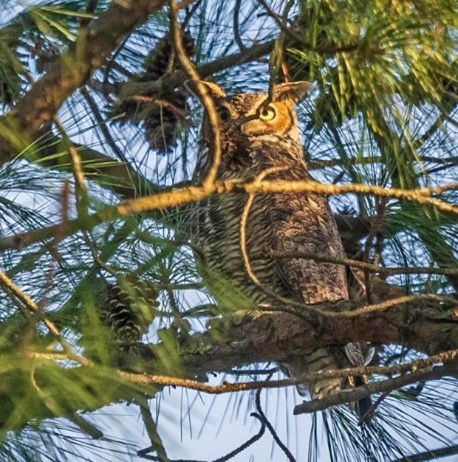
This great horned owl was photographed in forest near a friend’s home in Wild Rose Shores. It is the second largest owl in N. America and a fierce predator, natural rodent controller, and can take prey items larger than it, including rabbits. The more you look, the more you see. (Kenneth Graham/Courtesy)
You can also escape to other natural areas in the region. Blackwater National Wildlife Refuge in Cambridge is a gem in the winter with tens of thousands of migratory waterfowl, from tundra swans to snow geese. You will also see bald eagles. It is an easy day trip from the Annapolis area.
For your physical and mental well-being, I recommend getting out into the natural world and allowing Mother Nature to imbue you with her wonders. The sounds and sights of nature will open the door for you to enjoy the greatest show on earth.
Gerald Winegrad represented the greater Annapolis area as a Democrat in the Maryland House of Delegates and Senate for 16 years. Contact him at gwwabc@comcast.net.