Gerald Winegrad: Trump’s insane war on wind energy | COMMENTARY
“The answer, my friend, is blowin’ in the wind.” Bob Dylan (1962)

Trump’s War on Wind resulted in a $1 billion payment to France’s TotalEnergies (here with Interior Secretary Doug Burgum) to stop plans for wind farms offshore of New York and North Carolina that would have produced clean electricity for 1.3 billion homes and businesses. Instead, TotalEnergies must use the money for a liquefied natural gas facility in Texas, shale gas production and oil drilling. (Ronaldo Schemidt /AFP/Le Monde)
Since taking office again on Jan. 20, 2025, President Donald Trump has taken a wrecking ball to our nation’s conservation efforts, dismantling approved legislation, regulations and funding. Many bedrock initiatives were enacted under Republican presidents and with bipartisan efforts. Some date back more than 100 years, while others were enacted more than 50 years ago. Other environmental measures destroyed are more recent.
One of Trump’s major environmental reversals is his blockage of clean and cheap sustainable energy from wind and solar projects. Since this occurs as electricity demand is rising faster than at any point in decades, I perceive this to be so blatantly stupid as to approach insanity. This madness is leading to spikes in the price of electricity, concerns over grid reliability and unnecessarily pumping more toxic chemicals into our air and waters while boosting global warming gases.
From 2000 through 2025, wind and solar installations accounted for more than half of all new U.S. electrical generating capacity. This staggering growth accelerated significantly in recent years, with wind and solar regularly providing over 88% of all new capacity additions, including last year. Iowa’s wind farms produce 64% of its electricity, while wind provides 22% of Texas’ electricity.
Wind now produces 10.5% of our electricity, growing from 1% in 1995. Wind power has accounted for roughly 35% of all new generation capacity built over the last two decades. That’s enough for 46 million American homes, making it the largest source of renewables. This occurred because wind is a clean, cost-effective alternative energy choice — the unsubsidized cost of wind power fell by 60% to 70% since 2010. Onshore wind is typically the cheapest new source of electrical energy in many areas.
With Trump’s war on wind, wind power increased by only 3% in 2025 despite the U.S. being in the midst of the largest surge in electricity demand since 2000, driven by data centers.
Trump’s relentless efforts to stop all wind projects, including those under construction, began on his first day in office in 2025 when he issued an executive order to block new approvals of wind farms on federal lands, including offshore. He used a bogus claim of national security threats.
The Interior Department expanded attacks in late December by blocking five Atlantic offshore wind farms approved and under construction before Trump took office. Their approval came only after years of reviews and studies, including by Interior. About $25 billion had been spent on erecting these projects.
Located off the coasts of Virginia, New York, Rhode Island, Connecticut and Massachusetts, they were critical power sources for electrical grids challenged by unprecedented demands from AI and other data centers promoted by Trump. These demands are driving up wholesale energy costs and straining household electricity bills.
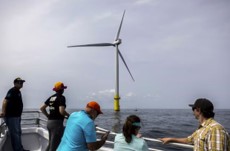
Employees of Dominion Energy check one of its 176 wind turbines being built 27 miles from Virginia Beach in the Atlantic Ocean. The project is 70% complete and already generating clean electricity. The Trump administration’s stop work order was overturned by a federal court at a delay cost to Dominion of $228 million. (Kendall Warner/The Virginian-Pilot/TNS)
The wind companies and northeastern states prevailed in federal court suits, allowing the five projects under construction to proceed. To counter these decisions in March, the Trump administration decided to begin paying wind power developers billions in taxpayer funds to abandon their planned offshore wind projects. French energy giant TotalEnergies agreed to take $1 billion to cancel two major offshore wind projects and halt future U.S. wind developments.
The Trump government also reached deals with Bluepoint Wind (N.Y./N.J.) and Golden State Wind (Calif.) to pay $885 million to cease development on their projects. These funds are intended to be repurposed into fossil fuel projects, such as liquefied natural gas. A coalition of seven states, led by New York, sued the Trump administration, arguing that these deals violate federal law, raise electricity costs and rob their states of needed power. The case is pending.
On June 17, Trump’s war on wind escalated, using $765 million more in taxpayer money to pay Invenergy to abandon plans to build four offshore wind farms in the New York Bight, off the Central Coast of California and in the Gulf of Maine. Invenergy must use the money for five new natural gas power plants in the Midwest and for western geothermal projects.
Combined, these offshore wind projects would have produced cheaper, clean electrical energy to power about 10 million homes. Instead, we are paying $1.65 billion to stop this electricity from flowing and replace it further down the road with dirtier, more costly power.
Since April, stupidity has turned to insanity as the Trump Pentagon blocked all private, land-based wind projects by refusing to process required military reviews of proposed wind farms. These reviews were meant to ensure that turbines don’t interfere with local radar or flight paths and were routinely completed within several months.
At least 106 planned wind projects in 21 states have been stalled indefinitely, representing $47 billion in potential investments, 120,000 lost jobs and enough electricity to power 8 million homes. A May 31 federal lawsuit to overturn this blockage is pending.
Many countries have wisely seized on wind power for cheaper, cleaner electrical power — Denmark: 58%-83%; Ireland: 54%; Uruguay: 45%; Germany: 42%; Portugal: 29%; England: 29%. But the U.S. under Trump is moving backwards on clean, cheaper wind and solar energy. Against all market realities and common sense, Trump has insanely done all in his power to promote coal, the dirtiest and most dangerous fuel on Earth.
Ominously, in 2025, U.S. greenhouse gas emissions increased by about 2.4% over 2024. This reversed declines and was largely driven by a 13% surge in coal usage stimulated by Trumpian policies.
Trump’s One Big Beautiful Bill significantly restricts wind and solar energy growth by eliminating key federal tax subsidies, including eliminating common-sense Investment Tax Credits and Production Tax Credits for wind and solar facilities.
Thanks in part to the no win(d) Trump policies, the first quarter of 2026 was the slowest start to the year for new installations of land-based wind power since 2018. Even oil and gas interests and the U.S. Chamber of Commerce expressed concerns over stopping already approved wind projects.
Could it be that Trump’s hatred for wind power stems from losing his 2015 battle to stop a wind farm from being built off the coast of a golf course he owns in Scotland in 2015? How else can his wind energy phobia be explained, as he promotes massive AI and other data centers while electrical demand grew by 2.8% in 2025?
After years of robust growth, electrical demand leveled off from 2008 through 2021, growing by an average of just 0.1% to 0.5% per year. This is attributable to gains in energy efficiency, offsetting population and economic growth. But sharp increases in demand have caused electricity prices to surge. With data centers’ electricity use projected to double by 2030, U.S. demand for electricity is predicted to grow 24% by 2030.

One of more than 632 data centers induced to build in Virginia’s Data Center Alley driving up the regional demand and cost for electricity. Virginia hosts 150 of the world’s largest hyperscale facilities (Jahi Chikwendiu/The Washington Post)
How we produce this electricity will have profound effects on all U.S. residents, including the costs and availability of power, impacts on our land, water and air from extracting and burning non-renewables, our public health and global warming.
Next week’s column will cover Trump’s attack on solar power and energy efficiency while forcing the use of more expensive coal, including reversing the closure of polluting, inefficient coal plants at a cost of $800 million in taxpayer funds.
Gerald Winegrad represented the greater Annapolis area as a Democrat in the Maryland House of Delegates and Senate for 16 years. Contact him at gwwabc@comcast.net.