GERALD WINEGRAD: WHAT THE CHESAPEAKE BAY IS REALLY TELLING US | COMMENTARY
Maryland’s Environment Secretary Serena McIlwain recently posted an op-ed, “What the Chesapeake Bay is trying to tell us.” The secretary left many gaps, omitting what the bay is really telling us.
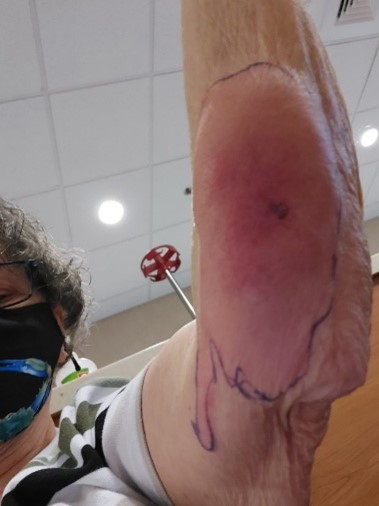
Patty Pecock’s flesh-eating disease necrotizing her arm from a cut on her pier tending her crab pots on the Harness Creek. Such infections are proliferating from excess nutrients in warming waters, an issue ignored in the new Bay Agreement. (Courtesy Photo)
First, the Chesapeake is loudly telling us now and has been for decades that it is not its warming waters that are the major problem. The secretary’s emphasis on warming distracts from the Chesapeake’s plea to stop choking her with excessive nutrients and sediment, primarily from agriculture and, secondarily, from development and forest loss. These pollutants are mainly the secretary’s responsibility to regulate, and Maryland has not met its duties under the federal Clean Water Act.
This failure and that of other bay states leave the bay clearly telling us that her waters are so polluted that 70.2% remain impaired (polluted) in violation of the Clean Water Act. This is a minuscule improvement since 1985, when 73.5% of Bay waters were impaired. The goal was to reduce impaired waters to zero by 2010, delayed to 2025 and missed again — without any sanctions.
Excessive nutrients are at the root of the Chesapeake’s demise, and they are leading to increasing cases of human flesh-eating diseases from water contact. People are losing fingers, limbs and even their lives as nutrients in warmer summer waters cook and feed bacteria that multiply and become more toxic, attacking human flesh. The shock-trauma center is treating many more of these cases, and the Maryland Health Department has seen a quadrupling of cases over the last decade.
The Chesapeake can also be heard lamenting that 78% of her waters are still contaminated with toxic impairments when the goal was zero.
While omitting the Chesapeake’s cry for help on these issues, the secretary mentions that warming waters may cause the demise of Tangier Island. But this is nothing new. More than 400 islands have disappeared beneath the Chesapeake Bay since 1600, many before industrial-age warming.
Holland Island, near Crisfield, once had 360 residents and 70 homes. It was abandoned 104 years ago and is gone. Many islands succumbed to natural land subsidence (the geological settling of the region) and erosion.
The secretary mentions warming water impacts on oysters and crabs. This is another red herring, as the jury is out on such effects. In 2023, the secretary’s boss, Gov. Wes Moore, pleaded for federal money because of an “ongoing commercial fishery disaster in the Maryland waters of the Chesapeake Bay … Since 2012, landings of seven of Maryland’s marquee commercial fishery species have declined between 27% and 91%. The dockside value has likewise declined between 12% and 85%.”
The species included blue crabs, rockfish, white and yellow perch and eels. The request did not mention warming waters. Rather, the governor chose to blame invasive species for the fishery disaster. The request was denied. What the bay is telling us is that poor water quality, overharvest and the failure to properly manage fisheries are to blame for her fishery declines. These include long collapsed fisheries such as shad and soft clams.
The secretary also failed to mention how submerged grasses (SAV) have declined and how important they are to the Chesapeake’s proper ecological function. They serve as her nursery for crabs and many other species, and as feeding grounds while stabilizing shorelines against erosion and soaking up nutrients. Maryland and other states have repeatedly broken promises, starting in 2000 when commitments were made to restore 185,000 acres by 2010 of these living bay meadows.
Instead of curbing nutrients and sediment to bring back grasses, Maryland has joined in efforts to lower the goals into the next decades. SAV declined in 2024, leaving total coverage at a paltry 82,778 acres, 45% of the goal set in 2000.
Warming waters are a problem but should not detract from the CODE RED facing the bay from excess nutrients and sediment. The secretary rightly touts the significant reduction in nutrients from wastewater treatment plants, the singular success of Maryland’s bay restoration.
This was paid for by $1.6 billion collected from water and sewer bills, now $60 a year. Often referred to as the “flush tax,” this successful effort began in 2005 and was initiated by Gov. Bob Ehrlich. The Moore administration had nothing to do with this success.
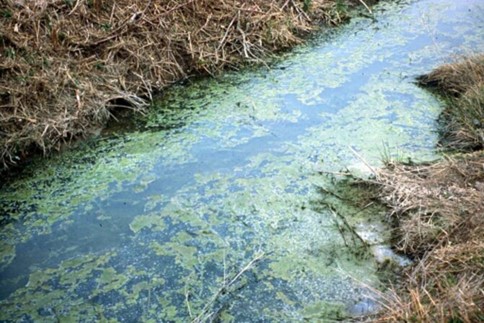
Agricultural nutrient and sediment runoff is the main culprit in poisoning the Chesapeake and surely the MDE Secretary knows this but fails to note the need to curb it. (Chesapeake Bay Program)
While the removal of nutrients at wastewater treatment plants has helped Maryland achieve required phosphorus reductions, the secretary fails to mention the failure to meet required reductions for nitrogen flows linked to agriculture and development.
Maryland has fallen far behind in the proper regulation of agricultural pollutants, including nitrogen, especially from huge concentrations of manure from chickens and other animals. The Chesapeake is telling us that she knows agriculture is the major bay polluter and is asking: When will you do something to significantly curb these pollutants — they are killing me! Development, both existing and new, continues to pollute the bay, and efforts have failed to significantly curb it.
Secretary McIlwain touts tree plantings but conveniently fails to mention how the state has failed to meet its commitment to increase forest cover. Instead, Maryland lost 18,821 net forested acres from 2013 to 2021, the highest percentage loss of any Bay state except Virginia.
The Chesapeake is telling us she will keep getting sicker if we don’t stop killing forests. Since 1609, Maryland forest cover shrank from 95% to 39%. Instead of acting to protect remaining forest, $25 million was cut in Moore’s budget from Program Open Space each year for three years that was dedicated to state land purchases. Millions more in POS funds were diverted. Thousands of forested acreage could have been preserved with these funds.
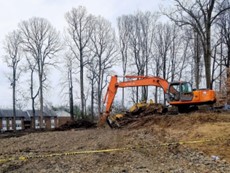
Maryland forest cover continues to shrink with disastrous impacts on the Chesapeake Bay as the Moore Administration looks the other way and fosters more AI and data centers. (Carol Swan/Courtesy)
Moore also took $10.5 million this fiscal year from the Maryland Bays Trust Fund, which underwrites efforts to reduce polluted runoff, including tree plantings. He also cut funding for the state’s four environmental agencies by 25% ($255 million). This occurs as Moore has been an outspoken advocate for expedited new housing construction and of AI and data centers that may impact forests.
Now back to the secretary’s emphasis on warming waters. She left out that the Moore administration in 2025 and 2026 raided $987 million from the state’s major fund to reduce greenhouse gas emissions, causing warming waters. This massive cut kills hundreds of solar installations and energy efficiency measures and prevents Maryland from meeting its emission reduction mandates.
The Chesapeake is pleading for help, but it is not coming. In late April, the director of the Maryland Sierra Club observed, “The environment, the Chesapeake Bay and climate were very far down the priority list.” The Moore administration has not initiated even one bold measure to restore the bay.
The bay is crying out for us to curb pollutants, with diminishing fisheries and life- and limb-threatening flesh-eating diseases from water contact. So, with all the secretary’s hand-wringing over bay warming, she appears not to have heard the bay tell her, “No more diversions from reality, it is past time to act to substantially curb agricultural pollutants — nitrogen, phosphorus, sediment and toxic pesticides — and those from developed and developing land. Maryland must stop stripping forests and adopt a no net loss law.”
We should all hear the Chesapeake Bay loud and clear.
Gerald Winegrad represented the greater Annapolis area as a Democrat in the Maryland House of Delegates and Senate for 16 years. Contact him at gwwabc@comcast.net.