RESTORING THE CHESAPEAKE REQUIRES POLITICAL COURAGE | COMMENTARY
Last week’s column detailed the embarrassing shortcomings of a farcically weak draft Bay Agreement to guide future efforts to restore the Chesapeake Bay. This draft new plan from the EPA-led Bay Program would be the fourth over the last 42 years. EPA also imposed a mandated pollution reduction plan, called a TMDL, in 2010 because of the failure to meet commitments to do so. The deadline was Jan. 1, 2025.
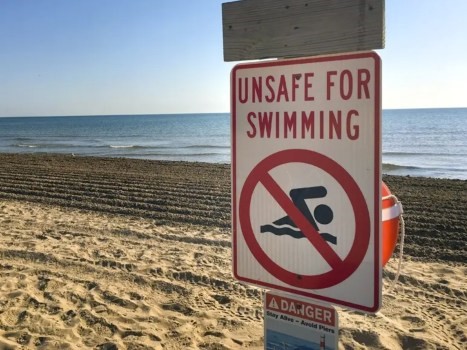
Beaches are closed after rainstorms of 0.5” or more and at other times because of contaminated runoff. Flesh eating infectious bacteria lurks in bay water threatening life and limbs as feckless “leaders” refuse to take the necessary steps to curb bay pollutants feeding the bacteria. (Courtesy photo)
After 15 years, the states failed again to meet the cuts in nitrogen, phosphorus and sediment (N, P, S). This leaves a polluted bay full of broken promises and deadly bacteria, causing flesh-eating diseases.
The draft plan discards or weakens previous commitments and placates the recalcitrant EPA, bay states and polluters. Contemplating my Oyster Harbor neighbor’s fight for his leg and life from a creek flesh-eating disease, I am embarrassed and angry that cleaning up the bay has sunk to such new lows. My neighbor has survived after three surgeries, hospitalization and is now at Shock Trauma, where he faces three more surgeries and skin grafts. We can and must do better.
Here is how. The political courage to do so and overcome vested special interests are the largest barriers.
Reduce N, P, S as dictated by the 2010 EPA TMDL
Each bay must meet N, P, S reductions set in 2010 by fully implementing EPA-approved watershed implementation plans. The TMDL limits shall remain until stricter limits are set to account for an additional 19 million pounds of nitrogen from more intensive agricultural operations and urban development (8 million pounds), the filled Conowingo dam reservoir (6 million pounds), and global warming (5 million pounds).
Since nitrogen reductions from non-point sources have been overestimated by as much as 50% since 2010, new recalibrations must include this additional nitrogen.
The states shall meet 75% of their current N, P, S reductions by the end of 2028 and 100% by 2030. If increased by a tighter pollution cap, they must meet a 2035 deadline. Under no circumstances should the new restoration plan abandon the pollution diet or the watershed implementation plans. They remain at the heart of the 2014 bay agreement, critical to achieving water quality. Abandoning these science-based limits because of states’ failure to meet them after being given 15 years makes a sham of bay restoration.

Last week, Gerald’s neighbor cut his leg on his Oyster Creek pier. A flesh-eating bacterial infection set in requiring hospitalization and operations both in the intensive care unit in Annapolis and at Baltimore’s Shock Trauma Unit. He will need 3 more surgeries after skin grafts. (Courtesy)
Impose sanctions for failure to reduce pollutants
Previous agreements were voluntary while the TMDL was considered mandatory. EPA listed possible sanctions for non-compliant states but failed to impose any despite gross failures.
The EPA and states must agree that after four decades of failure to meet commitments, penalties will be imposed after 2030 and 2035 deadlines for failure to meet deadlines on agreed-upon terms and reductions. Sanctions can range from withholding federal grants to blocking new discharge permits for new water and air emissions.
Mandate requirements for agricultural pollutant reductions
The major reason for an impaired, polluted Chesapeake is the failure to curb agricultural nutrients and sediment. Despite more than $2 billion in federal grants and millions more in state dollars given to farmers to implement pollution reduction practices since 2010, there has been no measurable decline in farm nitrogen flows to the bay.
About 90% of planned future nitrogen reductions must come from agriculture, the bay’s largest pollution source. The task has become much more difficult as agricultural intensification has added more fertilizer and farm animals and manure pollutants. Remarkably, the plan is devoid of measures to reduce agricultural pollutants.
A collaboration of 50 bay scientists warned that throwing more money at farmers for voluntary measures has not and will not work well. They have suggested a pay-for-performance grant system whereby farmers receive cash only for implementing measures that are independently certified to reduce N, P, S. All agricultural grants should be contingent on the effective implementation of best management practices under advanced nutrient management plans.
Manure from farm animals applied to land should be regulated in the same manner as advanced wastewater-treated biosolids. These include prohibiting the application on farm fields containing excess phosphorus, no winter applications and incorporation of manure into the soil by the end of the day or no later than 24 hours after application.
Regulations covering nutrient management plans and large animal feeding operations, including chicken growing facilities, should be fully enforced by on-site inspections by independent third-party entities. Forested buffers of at least 100 feet should be required around all bay and river waters adjoining farmland.
Increase forest cover and stream buffers
The 2014 agreement dictating increased forest cover and forested buffers around riparian areas was an abject failure, as both declined. The new plan has no goal for increased forest cover, which should be 10,000 net acres by 2030 and 25,000 by 2035. The current annual 900-mile, 100-foot-wide riparian buffer goal should be met by 2035. States should enact no net loss of forest laws from development as Annapolis did in 2012 and prohibit development of existing buffers up to at least 100 feet.
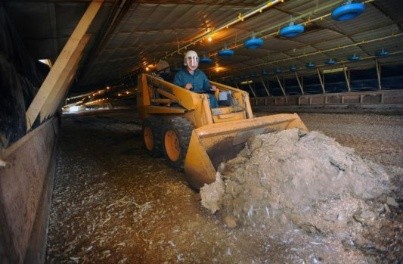
Most of the millions of pounds of chicken manure from 600 million E. Shore chickens are dumped raw on farms polluting the bay and groundwater. But the new bay clean-up plan is silent on curbing agricultural pollutants, the greatest pollution source and impediment to restoration. (Baltimore Sun Staff File)
Establish 85,000 wetland acres and enhance 150,000 acres
This is the same goal set under the 2014 agreement for 2025. The bay states failed to meet these critical commitments by huge margins.
Address urban stormwater pollution
Nitrogen flowing from urban stormwater has increased since 2010, violating commitments for substantial reductions. States should be required to meet their WIP plans on stormwater pollutant reductions by 2030 and enact laws that require no increases in rate, volume, or pollutant loads from all new development.
Increase oyster population by 10-fold
The bay states committed in their 2000 bay agreement to achieve a 10-fold increase in bay oysters by 2010 over 1994 levels. Instead, oysters declined. The 10-fold goal was abandoned. It should be reinstituted as oysters are a keystone species with significant water quality and habitat values.
Despite an uptick in population, oysters are still a small fraction of historical levels. Wild oyster harvests should be phased over a five-year period with compensation for oystermen to help them shift to aquaculture. Researchers found that if harvest had ceased in 1986, adult oyster abundance would have increased 15.8 times by 2009. Instead, it dropped by 92%. They called for a harvest moratorium.
Address Conowingo Dam reservoir nutrient overflow
This is adding 6 million pounds of nitrogen to the bay a year and its removal from the reservoir, along with sediment and phosphorus, must be covered under the new plan.
These thick intertidal grasses at our Oyster Creek bulkhead gradually disappeared from rising water levels from global warming. This important loss is occurring bay wide. (Carol Swan/Courtesy)
Global warming must be addressed
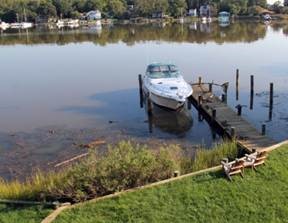
These thick intertidal grasses at our Oyster Creek bulkhead gradually disappeared from rising water levels from global warming. This important loss is occurring bay wide. (Carol Swan/Courtesy)
All references to climate change/global warming are excised from the agreement despite coverage in the 2014 agreement. Such warming adds an additional 5 million pounds of nitrogen annually.
More powerful and frequent storms increase water pollution from runoff and stream erosion. Higher temperatures put species at risk, deplete oxygen and reduce some submerged bay grasses. Rising sea levels cause flooding, erosion. and destruction of inter-tidal grasses as at my home on Oyster Creek.
By 2055, climate-related nitrogen increases are projected to be four times greater than during the last 30 years. Climate change must be forcefully addressed.
You can comment on the plan and prevent a nothingburger from being used to kick the can down the road, avoiding responsibility for the despoliation of our once great Chesapeake Bay: Reach out to comments@chesapeakebay.net.
Gerald Winegrad represented the greater Annapolis area as a Democrat in the Maryland House of Delegates and Senate for 16 years. Contact him at gwwabc@comcast.net.