GERALD WINEGRAD: IT’S A TRAVESTY FOR CHESAPEAKE THAT A 56% GRADE IS CELEBRATED | COMMENTARY
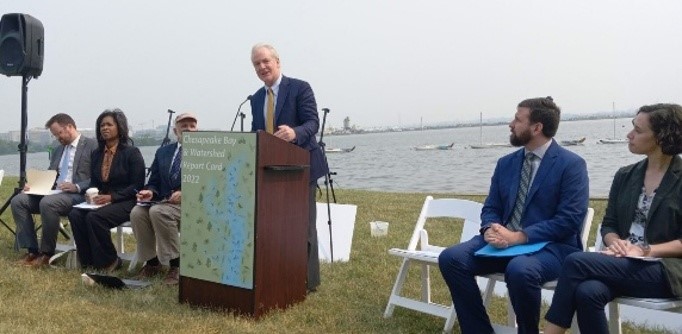
In Alexandria, Virginia U.S. Sen. Chris Van Hollen (D-Md.) addresses state secretaries of environment, natural resource officials, the incoming director of the EPA Bay program and environmental leaders at the 2023 release of the UMCES report card on Chesapeake Bay health. UMCES graded it 55%, a C+. CBF graded it a lowly 32 or D+. (Josh Kurtz/Maryland Matters)
By Gerald Winegrad,
As a student for 19 years and a graduate school professor for 11 years, a report card grade of 56% would always be an F, an embarrassingly low failure. But in a world turned upside down, a 56% rating for the health of the Chesapeake Bay is celebrated.
On Oct. 13, the University of Maryland Center for Environmental Science (UMCES) released its 2025 Chesapeake Bay Report Card in Woodbridge, Virginia. This was done with great pomp and circumstance, with accolades for the success of the Bay Program by high-ranking Maryland and Virginia officials, including a Virginia congressman. They were joined by the UMCES president in touting the success.
UMCES’ Integration and Application Network (IAN) biologists and statisticians evaluated the bay on seven selected measures and ranked it at 56% toward meeting health goals, a grade of C+. They point out this was the highest in 40 years, although their report card started in 2007. This was touted as a singular success showing how far we had come. The huge curve employed by UMCES and how they choose to establish their grading of bay and watershed health clearly convince me and should convince you how questionable this report card is.
The health of the Chesapeake Bay, if properly scored to include failure to meet Clean Water Act requirements, fishery declines and human waterborne infections, as well as other key criteria, would not be touted as its best in 40 years. Much of the bay watershed experienced a severe drought in 2025, resulting in much less rainfall. This significantly reduced highly polluted runoff from the 30% of the watershed in farms and the 5% in developed impervious surfaces.
When the Bay Program calculates actual nitrogen, phosphorus and sediment pollutant levels in any given year, it typically adjusts for rainfall. UMCES does not do so.
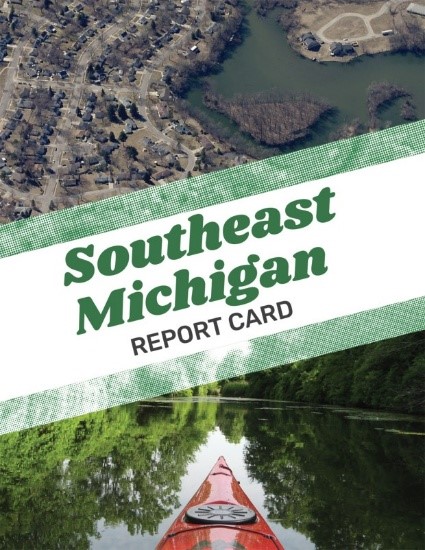
The UMCES IAN has contracted with dozens of groups from around the world to perform report cards modeled after their Chesapeake ones. Five Southeast Michigan river and watershed organizations sought socio-environmental report cards and received an overall 49%, a C grade. (IAN/UMCES)
Their 2016 and 2017 report cards graded bay health at 54%. In 2022 and 2023, it was graded a 55%. In 2018, UMCES noted that “since 2015, Chesapeake Bay Health Scores have consistently been in the high C range (53-54).” So, what’s the big news about a marginally increased score of 56% in an extreme drought year?
UMCES also changed the scoring for Chesapeake Bay health to buttress scores. Indicators for social and economic health were added in the June 2021 report card. Included were data about social vulnerability — response to hazardous events. Walkability is measured by how many people can walk to a park within 10 minutes from home. A Heat Vulnerability index uses metrics and households in poverty to assess vulnerability to heat. And data on household income, job growth, income equality and affordable housing measures is assessed.
These changes were made during Larry Hogan’s governorship when he was considering a run for president. Boosting the scores helped with the poorer water quality measurements and ingratiated UMCES and its staffers, including scientists, with governors and policymakers so they could have them join them in making announcements of the great progress in bay restoration.
Such scores as their 2006 D+ grade reflected that the bay’s overall health was still below the ecological thresholds set by the Chesapeake 2000 Agreement. This did not win UMCES, a state-funded institution, enhanced standing with Maryland’s governor, other elected officials and cabinet secretaries.
I know that Maryland governors pressured UMCES to increase annual report card grades to burnish their reputations. In 2014, while attending a local Sierra Club meeting at which I was presented an award, the speaker was from UMCES. He spoke about bay issues and covered their annual report card. He told those present how Gov. Martin O’Malley interceded with UMCES higher-ups to try and cajole them to increase the score on the report card.
In 2013, the report card gave bay health 45%, a C; in 2014, it rose to 50%, still a C. In running for president, O’Malley declared on his website, “I saved the Chesapeake Bay.” Hogan, in his second inaugural address on Jan. 16, 2019, declared, “We practiced skilled stewardship of the environment, which resulted in a Chesapeake Bay that is cleaner than it has been in recorded history.” His office also pushed to boost the UMCES report card.
The Chesapeake Bay Foundation (CBF) issued much more realistic and detailed bay report cards from 1998 to 2023. The last one for 2022 gave the bay a D+ or a 32; 2020 earned the same grade. Receiving Fs were nitrogen, water clarity, oysters and shad. UMCES scores do not include fisheries. A 32 was just a bit above the 27 of 1998, their first report card.
In 2022, UMCES increased its bay rating to a 51% or C grade. For 2020, UMCES highlighted that the Chesapeake watershed was in good health and rated a B-, while bay health was rated a C. Contrast these ratings with CBF’s more realistic ratings. After their January 2023 low report card, CBF ended their competition with UMCES and ceased report card publication after 25 years. CBF advised me they were revamping their report card and expect to publish it in the second half of 2027.
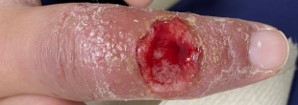
Luke, a 15-year-old, fought a six-month battle, including weeks of hospitalization, with a Mycobacterium marinum infection in his finger contracted while handling rockfish on the Chester River. Someone should tell him and other victims of even worse infections how much the Bay has improved. (Luke Helfenbein/Courtesy)
The report card conveniently ignores the fact that the bay states fell well short of meeting their mandatory pollution reduction requirements for nitrogen, phosphorus and sediment required under a pollution diet called a TMDL. This mandatory dictate was imposed by the U.S. EPA in 2010 and was to be met by 2025.
This left 71% of the bay’s water polluted in violation of the federal Clean Water Act, as documented by the EPA Bay Program. This is the most objective, most comprehensive, most accurate and cheapest Chesapeake Bay report card. The amount of bay water in non-compliance increased slightly from the previous two years of EPA evaluations.
In a May 2023 report, 50 top bay scientists on the Bay Program’s scientific advisory committee reported that the best that can be said is that at least the bay has not gotten worse over the last 40 years.
The IAN of UMCES has found a niche to both gain funding and ingratiate itself with governors, lawmakers and environmental agency officials. Run by a specialist in data analysis and communication and by a Ph.D. termed a science integrator, they contract with dozens of associations dedicated to restoring various water bodies around the world.
Their clients include restoration groups for Long Island Sound, Lake Erie, Detroit River, Rio Grande, Orinoco River (mostly in Venezuela) and Fiji coasts. The EcoHealth Report Card’s website states, “Imagine if your research could mobilize volunteers to protect their local river or inspire politicians to fund restoration activities … That’s just what we’ve achieved.”
Funders of the bay report card include the National Fish and Wildlife Foundation, a federally related entity and the EPA Chesapeake Bay Program.
My conclusion is that subjectively choosing what is evaluated and how scores are graded and curved makes the IAN successful in attracting politicians and others to fund their report cards, 23 staffers and some restoration. If they were regularly grading a D or D+, as CBF was doing recently, there would not be the turnout of so many high-ranking elected and cabinet people, nor would there be funding by federal, state and NGOs who hire them to produce the report cards.
Gerald Winegrad represented the greater Annapolis area as a Democrat in the Maryland House of Delegates and Senate for 16 years. Contact him at gwwabc@comcast.net